The Golden Era of Slovak IT: How We Developed Our Own Computers and Bypassed the Embargo
Is Slovakia doomed to remain forever just the assembly workshop of Europe? When we talked to engineer Štefan Kohút in the latest episode of the Biznislab podcast, we found out that there is much greater technical creativity rooted in our DNA than we can admit today.
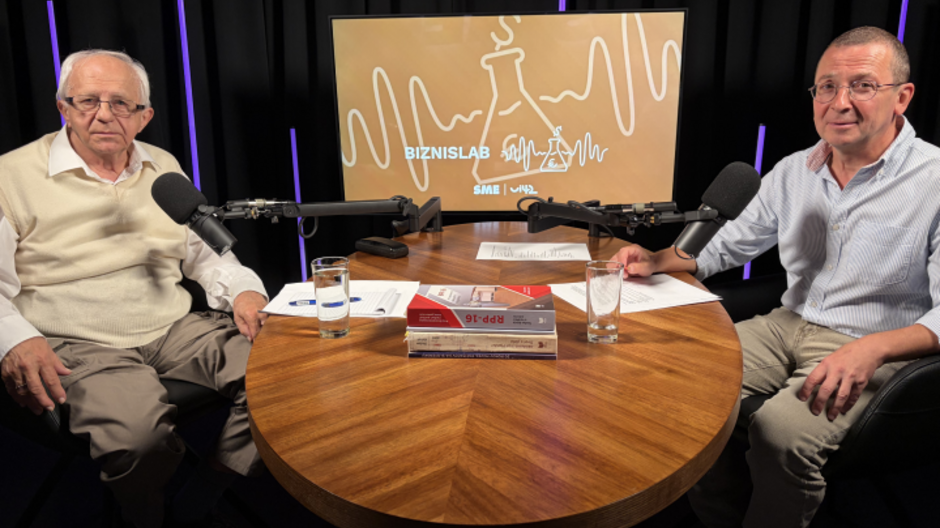
Štefan Kohút is a former director of the Computing Center of the Slovak Academy of Sciences, founder of the Computer Museum, and a man for whom the history of computers is not only a lifelong profession but also a mission. Our conversation was a fascinating journey into the 1960s and 1970s – a time when a few enthusiasts in Slovakia were building machines that were ahead of their time.
From Analog to the Revolutionary RPP-16
Do you know what problem the first Slovak computers solved? It wasn't about playing games. It started with analog devices, where data was measured in volts and used to solve complex differential equations in practice. One of the first applications was calculating the optimal suspension of incubators in ambulances. The system was designed so that babies would not suffer from bumps during fast transport over the potholes on the roads at that time.
The real breakthrough, however, came with the need for more precise digital calculations. Thus, the legendary RPP-16 (Rapid Program Processor) began to be developed at the Slovak Academy of Sciences under the leadership of Ivan Plander as early as 1965.
Developing a proprietary 16-bit digital computer during the Cold War, moreover under strict embargo on Western technologies, was an extremely daring project.
Developers literally had to "smuggle" American integrated circuits with the help of Danish colleagues, but the result was a fully functional and reliable Slovak control system. The RPP-16 successfully managed production in Nováky, synchronized the Váh cascades, and even protected miners' lives in Ostrava.
Are you interested in more technical details about development in our country? Also, read our older article about how Slovak computers were created.
PMD 85 and the Garage Revolution in a State Factory
The second gem of our conversation was the birth of the very first personal computer in our country – PMD 85 (Piešťany Microcomputer Display). Did you know that its first prototype was literally made from "scraps"? A young engineer, Roman Kišš, who worked at Tesla Piešťany, built his own logical systems from discarded circuits that were destined for the trash after working hours.
The real breakthrough for PMD 85 came in 1982. Kišš was tasked with traveling to Prague and presenting the new memory circuits at the ministry. Since the chips themselves cannot be visually presented, he devised a sophisticated electronic board that could continuously read the memory content from both sides (for the processor and the screen) and displayed zeros and ones directly on a regular TV.
A Lesson in Management from the 1970s
For today's leaders and business owners, this podcast offers amazing inspiration in the field of motivation. How did management work 50 years ago when you couldn't promise people bonuses or corporate benefits?
People worked for free. However, they were so excited about the opportunity to create their own innovations that – as Mr. Kohút recalls – after the institute was locked, they would jump back in through the window to crack codes and improve circuits at night. It was about vision, autonomy, and pride that even small Slovakia could create top-notch things.
Listen to the entire captivating episode on your favorite platforms, where you'll also find out how tractor drivers in Slušovice received bonuses thanks to computers and what important challenge Štefan Kohút has for today's "IT guys".