Viktor Doletina from ui42: AI agent, MCP and the future of e-commerce companies
AI agents are no longer just a technological experiment. Viktor Doletina, Head of AI from ui42, explains how they are changing the functioning of e-commerce companies, why they need access to real company data, and what role MCP plays in this.

Artificial intelligence is no longer just about a chatbot to which you give a prompt and wait for a response. The next step is AI agents – systems that can work with data, use tools, and independently perform specific tasks.
In the new episode of the Biznislab podcast, we discussed with Viktor Doletina, who is responsible for AI transformation at ui42, what this shift means for companies in practice.
We are thus building on the previous episode with Professor Mária Bieliková, who talked about how not to panic and fall into chaos during AI innovations. This time, we move from principles to concrete implementation - how to connect AI with company data, what MCP enables, where AI agents already make sense today, and why humans cannot be completely left out even with them.
From chatbot to AI agent: what's the difference
A regular chatbot receives one prompt from you and returns one response – text, image, solution proposal. The decision on what to do next is always up to the human.
An AI agent works differently. As Viktor Doletina explains, the word "agent" itself captures its essence well - it is someone who acts on behalf of someone else. An insurance agent concludes policies on behalf of the insurance company, a travel agency arranges trips for the client. An AI agent operates on a similar principle: it receives a goal, has access to the necessary tools and data, and then solves the task in individual steps without waiting for further instructions from a human at each step.
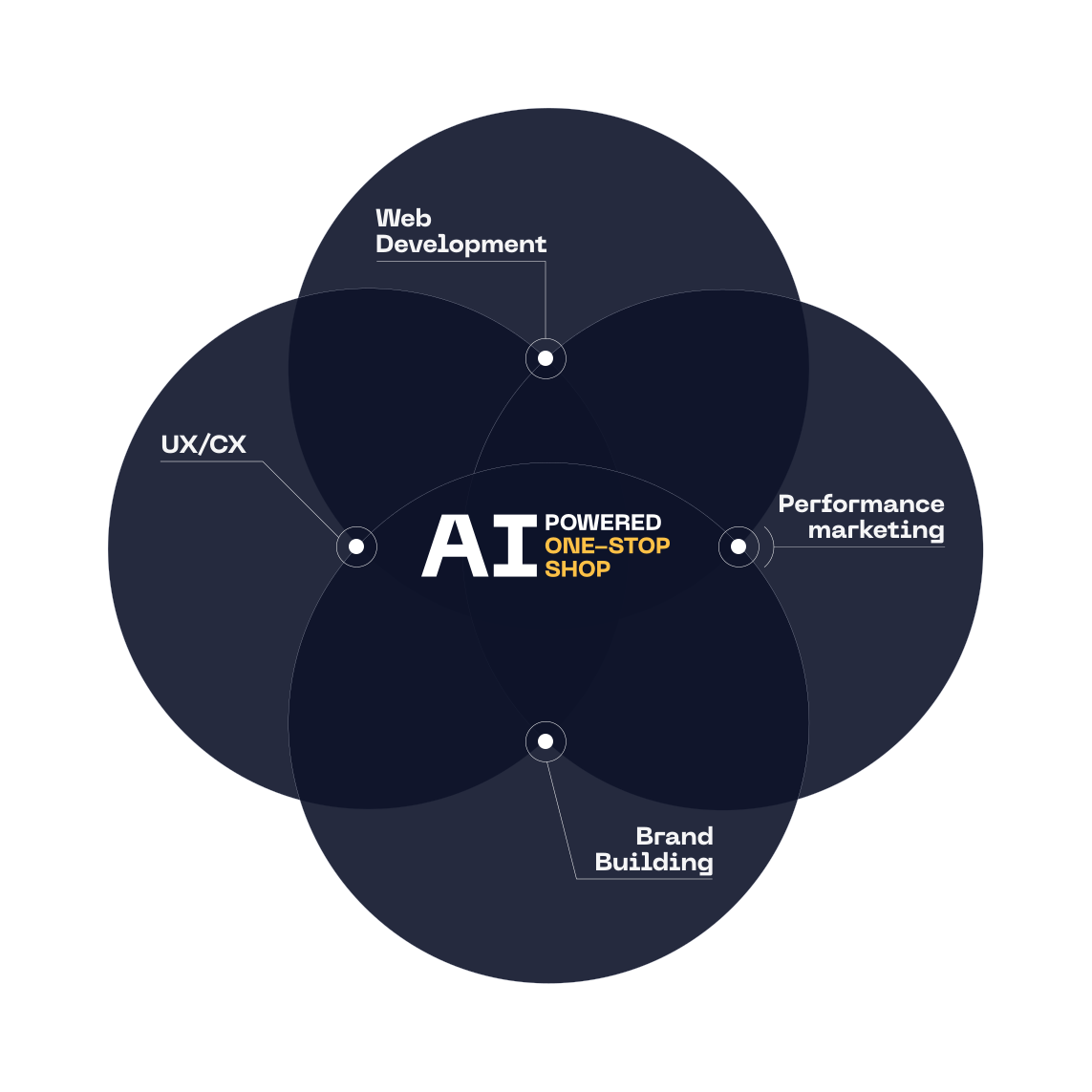
This has a direct impact on e-commerce companies and marketing agencies. Part of the tasks that specialists have performed so far - from performance marketing through UX to development - are now partially taken over by AI agents, who work faster, more reliably, and without the limitations of regular working hours.
Step 1: Connect artificial intelligence with your own data
Before a company starts deploying AI agents, according to Viktor it should solve the very basics: connecting AI with its own data – for example, from Google Analytics, internal systems, or customer data.
"Until artificial intelligence knows your business, your data, and your customer, it is just guessing and essentially shooting in the dark. Once it gets that background, the conversation is suddenly completely different," explains Viktor Doletina.
Without data, AI is just a general advisor. With data, it becomes a partner that can answer specific questions about your e-shop, not general questions about the e-commerce market. Viktor calls this "the essential step number one for anyone who takes AI seriously." The question is no longer whether it will happen, but when.
What is MCP and why is it like "USB" for artificial intelligence
Connecting AI with company systems is most often solved today by MCP (Model Context Protocol) – an open standard that defines how artificial intelligence connects to individual systems and data.
Viktor Doletina compares it to USB in the podcast. When you connect an external drive to a computer via USB, the computer can immediately work with the data stored on it - without having to deal with how exactly they are stored. It works the same way between artificial intelligence and company systems: Google Analytics, Google Ads, Meta Ads, internal ERP, or e-shop CMS system today commonly offer an MCP connector through which they can be directly connected.
In practice, AI can thus obtain the necessary context from various company tools and work with data that a human would otherwise have to manually search for and connect.
"Suddenly, I don't have to go searching for how much invoicing was where, how many tasks there were. I write one prompt, and it gives me the result," explains Viktor Doletina.
AI agents in practice: audit, PPC campaigns, and code review
How does the use of AI agents look in practice? At ui42, we already use them for several activities that would otherwise require a lot of manual work and time from specialists.
- Website accessibility audit. Conducting an accessibility audit (a requirement for websites since last year) is now automated by our own agent to such an extent that it can be done at half the cost compared to manual processing.
- Code review. The AI agent can continuously check the code and perform code reviews of changes from developers. It helps to detect potential errors before they manifest on the production website.
- Performance marketing. The agent can go through the entire PPC account in detail – check if each campaign is active, if it makes sense, where there are grammatical errors, or campaigns leading to a non-existent page (404). These are common errors that often remained unchecked due to time constraints.
We are building on a similar principle at ui42 with FLUIDUM AI – a team of specialized AI agents that continuously monitor digital business and connect data across systems. Instead of one universal chatbot, each agent has its area of expertise, and together they can uncover problems, connections, and opportunities across the entire e-commerce.
Risks of AI agents: hallucinations and human in the loop
AI agents are not infallible. Viktor mentions a specific case in the podcast when an agent, while working with data from Google Analytics, reported a turnover of 10,000 euros instead of the actual 5,000. At ui42, we have therefore introduced automatic control that compares the agent's outputs with real data from the system. Such an error has not occurred again for several months.
This is why the principle of human in the loop is important when deploying AI agents – keeping a human in the process, especially for decisions and tasks that can have a real impact on the business.
"As soon as AI has full autonomy, it's a ticking time bomb for when something goes wrong. It's important for a human to somehow verify, correct, or give final confirmation that yes, you can go ahead and do this."
Caution is also important when investing in AI itself. One of the studies focused on the use of generative AI in companies showed that up to 95% of the initiatives examined last year did not bring measurable financial effect. This year, it's approximately around 60%.
The problem may not be the technology itself. As Viktor points out, with the many possibilities AI offers today, it's easy to start experimenting without a clear goal. Before investing time, money, and other resources, a company should therefore do its "homework" and evaluate whether a specific use of AI has a real benefit for its business.
How much does an AI agent cost and is it worth it?
The costs of operating AI agents depend on the number of tokens consumed – essentially a new "currency" of artificial intelligence, where you pay for how much data the model processes. According to Viktor, ui42 spends thousands of euros monthly on operating its own agent systems, with practically no ceiling – the more complex the system (for example, an agent that checks another agent), the faster the costs grow.
Optimization is therefore as important as the deployment itself: choosing a cheaper model where the task allows it, corporate licenses instead of paying for API for regular use, or a solution architecture designed not to waste tokens on simple tasks.
With the expansion of AI into company processes, new rules are also emerging. The European AI Act is gradually introducing obligations in the area of AI content transparency. Therefore, when deploying generative AI, companies should not only address its possibilities and costs but also what legislative obligations apply to the specific way it is used.
AI needs a system, not enthusiasm
Viktor has personal experience with the rapid pace of AI transformation. In the podcast, he openly talks about a period when his enthusiasm for the new possibilities of artificial intelligence grew into burnout. And a similar principle applies to companies - mere enthusiasm for AI is not enough.
If artificial intelligence is to bring real value, it needs to know your business and work with its data. These need to be securely connected to systems, and only then should specific tasks and processes be sought where deploying AI agents makes sense.
It is therefore not important to deploy AI everywhere it can be. What is important is knowing where it will truly bring value to the company.