What is the Model Context Protocol (MCP)?
What does it mean
Model Context Protocol (MCP) is an open standard that allows large language models (LLM) to securely communicate with external applications, data, and tools through a unified interface. Its goal is to eliminate the need to create separate integrations for each AI model and each external system.
Instead of developing a multitude of custom connectors, an application only needs to support MCP. The AI assistant can then access company databases, CRM, ERP, cloud storage, APIs, or other services in a standardized way, regardless of who develops them.
The Model Context Protocol was introduced by Anthropic and is now supported by a growing ecosystem of AI tools and development platforms.
More info
Model Context Protocol as a Standard for AI Integrations
Modern AI assistants need to work with information that is not directly contained in the language model. This can include internal documents, databases, business systems, or corporate applications.
Without a common standard, each AI application must implement its own integrations with each system separately. This significantly complicates development and maintenance.
MCP solves this problem by introducing a unified protocol through which the AI model gains access to the context, data, and functions of external applications. Developers thus create the integration only once, and it can be used by any AI client supporting MCP.
Just as HTTP standardized communication between a web browser and a web server, MCP standardizes communication between AI models and external systems.
How Does MCP Connect an AI Assistant with Data, Tools, and Applications?
MCP allows the AI model to work not only with text but also with current data and functions available in external systems.
Through MCP, an AI assistant can, for example:
- search for information in internal documentation,
- access data from a CRM or ERP system,
- work with files in cloud storage,
- run defined tools or APIs,
- execute automated workflows.
Importantly, the language model itself does not directly access these systems. Communication takes place through the MCP server, which only provides access to defined resources and functionalities according to set permissions.
MCP Server, Client, and Host in Practice
The architecture of the Model Context Protocol consists of three main components.
Host
The host is the AI application in which the user works. This can be an AI assistant, a development environment, or another application supporting MCP. The host manages communication and can use one or more MCP clients.
MCP Client
The MCP client ensures the connection between the host and a specific MCP server. Each client always communicates with one server and transmits requests and responses according to the Model Context Protocol specification.
MCP Server
The MCP server provides AI applications with access to specific resources. It can provide access to databases, documents, APIs, tools, or other services. The server also determines what operations are allowed and what data the AI model can use.
Such an architecture allows for easy connection of various AI applications with enterprise systems without the need to create separate integrations for each AI model.
Why is MCP Important for Modern AI Applications?
Without a standardized way of communication, AI assistants remain reliant mainly on the knowledge stored in the model itself or on individually created integrations.
The Model Context Protocol allows for the creation of AI solutions that securely work with current corporate data, utilize existing enterprise tools, and easily expand to other systems. Developers do not have to implement new connectors for each AI model or each application separately.
This is why MCP is gradually becoming one of the most significant open standards for integrating generative artificial intelligence into the corporate environment.
Latest news

Phishing website: What to do when someone copies your e-shop?


How to verify an AI prototype before web development


Imunoklub Case Study: Unification of Two E-shops and More Value from Each Visit


ChatGPT Ads are here, are you ready?


Who is a design engineer and what do they do? A discipline at the intersection of design and code

When to start preparing Christmas campaigns?


Strategic Digitization of a B2B Company 3/3: Digitization Roadmap for the CEO

Finax Case Study: Digital Transformation of an Investment Platform Built on User Research


Strategic Digitization of a B2B Company 1/3: Why AI is Not the First Step
Contact us
Everything for the growth of your business in one place
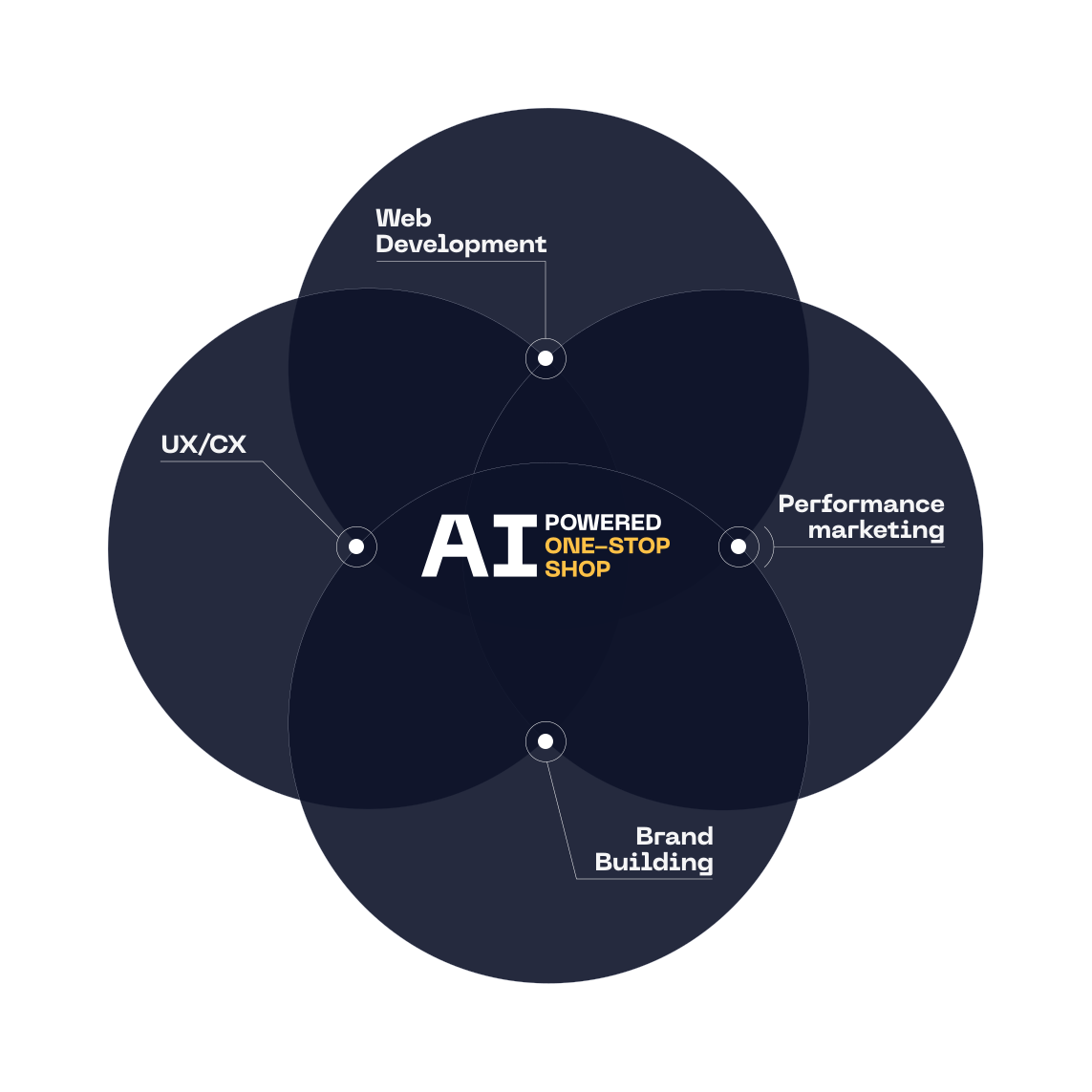
At ui42, we combine strategy, creativity, technology, marketing, and AI into one entity.
We build brands and visual identities, create websites and e-shops, design UX and CRO, create creative content, and deliver measurable results through performance marketing.
Our solutions are enhanced by FLUIDUM – ui42's AI intelligence, which transforms company data into a competitive advantage.
Thanks to this, you gain a partner who can cover the entire digital ecosystem of your business – from the first contact with the brand to conversion.
Don't miss out on the latest news from the world of UX, programming, analytics, and marketing.

Thank you for subscribing!

Get a free consultation
What do you need help with?
Select all options that apply to you
The form has been sent successfully.