
In the first article, we showed that digitalization is not an IT project, but a strategic change in the way a company operates. In the second, we explained why AI is not the first step in B2B digitalization, but rather an enhancement over quality processes and data.
In this article, we will look at how to approach the entire process in practice. From the initial mapping of business and processes through automation, customer portal, and data management to the deployment of AI where it brings real business value to the company.
Because the biggest problem with digitalization is usually not a lack of technology. Today, you have a plethora of options to choose from.
It is precisely the incorrect order of steps.

Companies often start by choosing a platform, vendor, or AI tool. Only later do they realize that they lack clearly defined processes, reliable data, unified business rules, or agreement on what problem the new solution is actually supposed to solve.
The result is an expensive process and system that technically works but brings with it a host of problems, from reluctance to use it to missing details that are critically important in B2B.
Step 1: Map the entire process, not just the order.
The most common mistake in digitalization projects is that only one part of the company is addressed. For example, a new e-shop, new ERP, CRM, or AI tool is implemented completely independently. However, the customer does not distinguish whether they are communicating with a salesperson, customer support, B2B portal, or e-shop. For them, it is still one company. Every interaction therefore affects the overall impression of the collaboration.
If a new customer finds you easily, but the business responds slowly, the resulting impression is bad. If the order goes smoothly, but the complaint takes two weeks, the customer is unlikely to remember the flawless checkout. And if the salesperson cannot quickly find the right price, check availability, or order status during a meeting, the customer does not care how many modern systems the company uses. They primarily perceive their experience – and in each of these cases, it remains negative.
Therefore, the first step in digitalization is not choosing technology or analyzing specific functionality. It is understanding the entire (not just business) process.
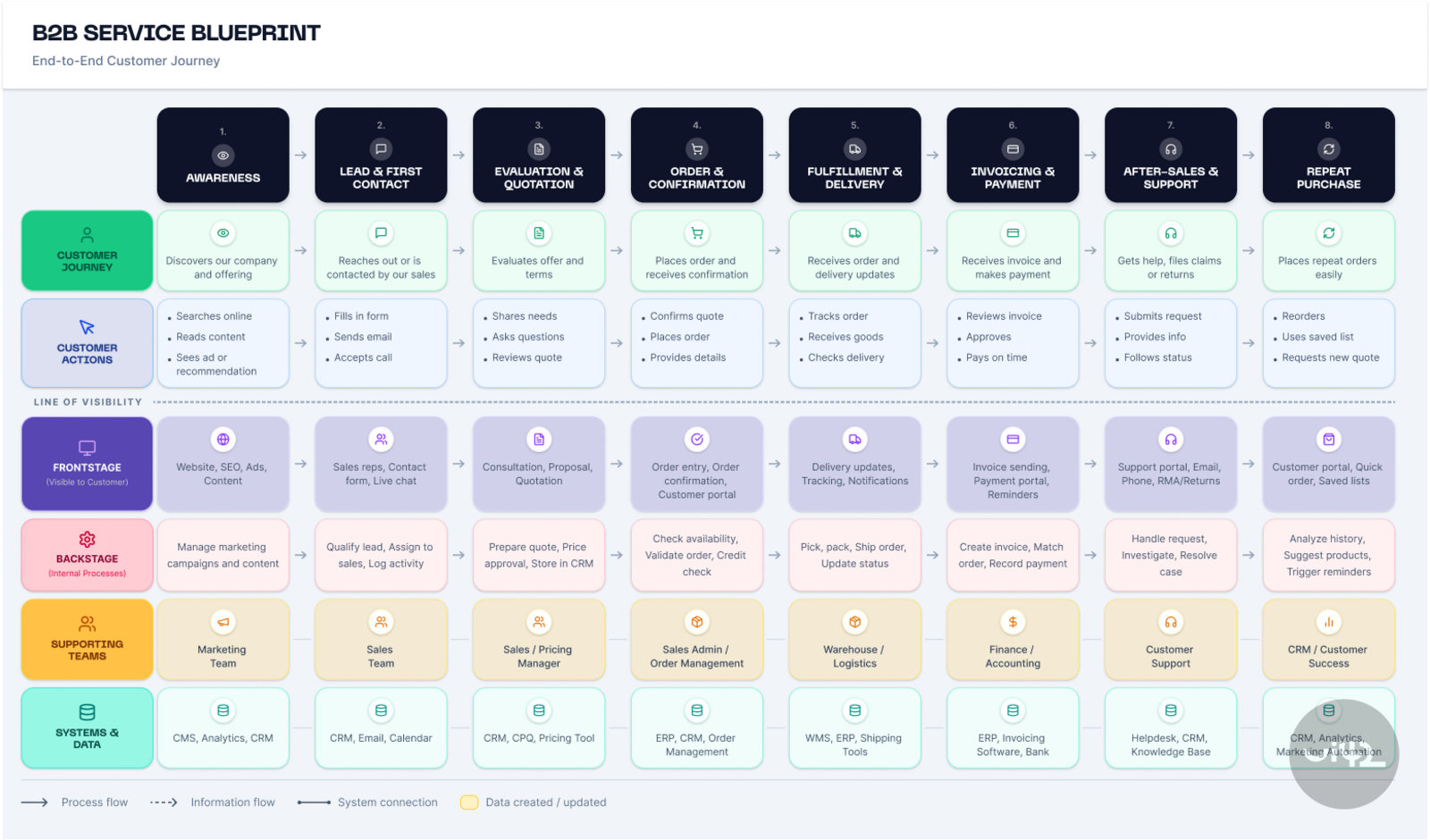
Start right at the beginning. How does a new customer reach you? Do they find you through a search engine, recommendation, advertisement, or expert content? Do they contact you actively, or does the first contact arise from a cold call by a salesperson? What information do they need at this moment, and who responds to their request?
Then continue through the entire customer lifecycle. What happens after the first contact? How does the company evaluate their potential, and who decides on the next steps? How is a price quote created, who approves individual prices, and where are the agreed conditions recorded? How is the customer entered into the CRM, ERP, or other system, and who is responsible for the accuracy and completeness of their data?
Similarly, go through the first order process in detail. Where does the order originate, who checks it, how is the price and stock availability verified, and who transcribes it into other systems? What happens when something is not in stock, when the price needs to be adjusted, or when the order requires individual approval? How does the information reach the warehouse, logistics, and invoicing, and how does the customer find out what is happening with their order?
Mapping should not end with delivery. It is equally important to understand what follows - how the customer receives invoices, certificates, manuals, or technical documentation, how complaints, service, or returns are handled, and who is responsible for resolving their requests. Pay attention to repeat purchases as well. Can the customer easily repeat a previous order? Do they have saved shopping lists available? Does the company actively remind them of regular purchases, or does it only notice their inactivity when orders stop coming in?
At each step, monitor the same areas: what inputs the process needs, what outputs it creates, what actions and decisions are made in it, what data changes, and which people or job positions are involved. Also, note which systems are used, where information is transcribed, where someone is waiting, where errors occur, and which rules exist only in the minds of experienced colleagues.
The goal is not to create perfect process documentation for the entire company. The goal is to see the entire flow of the customer, information, and decisions as one interconnected whole for the first time.
Very often, it is only during this mapping that it becomes clear that the problem does not lie where management originally imagined. The salesperson waits for the warehouse, the warehouse waits for approval, administration waits for complete data, and the customer waits for a response. Everyone sees only their part of the process and is convinced that the delay is happening somewhere else.
Only when the company understands the entire flow from acquiring the customer through order, delivery, and service to repeat purchase can it start deciding which parts make sense to change, simplify, or digitalize.
Therefore, only in the next step does the question arise of which activities are repetitive, have clear rules, and do not need to be performed by people every time.
Step 2: Find activities that don't need to be done by people
Once you have mapped the entire business process, the next step is to look at it from a completely different perspective. This time, don't look for what works or doesn't work in the company. Look for everything that repeats and ideally from the perspective that this step does not have a direct positive impact on business growth.
Look at the activities that employees perform every day when processing orders, communicating with customers, creating price quotes, handling complaints, or administration around sales. Very often, you will find that a significant portion of the working time of sales managers does not go to sales or customer development, but to routine tasks. Employees repeatedly answer the same questions, transcribe data between systems, check stock levels, verify individual prices, or search for information that already exists somewhere in the company.
A typical example is an order received by email. A salesperson or administrative worker opens the message, checks stock availability, verifies individual prices, transcribes items into the ERP system, prepares order confirmation, and sends a response to the customer. Each of these steps is correct in itself. The problem arises when the same procedure is repeated hundreds or thousands of times a month. Then it is no longer a minor administration but a systemic brake on growth.
That's why it's worth looking for activities that are performed frequently, follow clear rules, do not require individual human decision-making, and do not directly support business growth. These are the processes that bring the fastest return on digitalization. Every automatically processed order, every self-service downloaded invoice, or every customer who easily finds the necessary information themselves means less administration for employees and more time for activities that truly create value for the company.
Step 3: Establish a single source of truth
In many companies today, there are multiple versions of the same information.
The product price is in the ERP system, but the salesperson has a different price in Excel. Stock availability is checked by phone. Technical documents are stored on a specific employee's computer. Individual customer conditions remain in emails or in people's heads.
Such an environment can be managed for a certain time with personal commitment. However, it cannot be safely scaled and over time starts creating more chaos.
The company therefore needs to determine which system is the source of truth for individual types of data.
ERP can be the source of prices, stock levels, invoices, and orders. PIM or CMS can manage product information. CRM can contain the history of the relationship with the customer. The B2B portal makes this data accessible to the customer and salesperson in a usable form.
This does not mean that all data must be physically stored in one place. However, they must be interconnected, current, and trustworthy.
If the customer sees different availability in the portal than the salesperson in the ERP system, the digital channel does not increase trust. On the contrary, it destroys it.
Without a reliable data foundation, it is therefore pointless to talk about personalization, predictions, or AI recommendations.
Step 4: Shift routine from employees to the system
When a company knows which processes it wants to improve and which data it can trust, automation comes into play.
Not AI. Automation.
An order can automatically check availability after submission, consider individual prices, create documents in the ERP system, reserve goods, inform the warehouse, and send confirmation to the customer.
The customer can download the invoice, technical sheet, certificate, or manual themselves. They can repeat a past order, work with a shopping list, upload a bulk order, or track the status of a complaint.
Each such function removes one recurring request that previously had to be handled by a person.
However, it is important not to start with everything at once. Large digitalization projects often fail because the company tries to solve its entire business in the first version. The result is long development, complicated requirements, and a solution that users see only after many months.
A better approach is gradual, agile.
Start with a process that has a high frequency and a clear benefit. For example, self-service access to documents, repeat orders, or real-time product availability.
Then monitor usage, collect feedback, and add more functionalities based on real needs.
Step 5: Don't push salespeople out. Give them better tools.
One of the most common fears in digitalizing B2B sales is the idea that a customer portal or automation will cut sales managers off from customers.
Properly designed digitalization does the exact opposite.
Its goal is not to replace the salesperson. Its goal is to make them the best-prepared salesperson the company can send to the customer.
A sales manager should have real, current, and correct data available during any discussion with the customer.
They should immediately see purchase history, individual prices, open orders, complaints, product availability, unused offers, or changes in purchasing behavior.
If a customer needs to create an order during a meeting, the salesperson should not be calling colleagues in the office or connecting via complicated remote access. They should use the same fast and understandable tool that the customer uses and quickly click what they need on a tablet or laptop.
If salespeople use the same environment as customers (this does not mean that with role separation, the salesperson cannot have different permissions and extended options), they understand it better, can explain it, and bring feedback from the field.
Digitalization also saves them time in dealing with operations. Instead of sending invoices, checking stock, transcribing orders, or searching for technical documents, they can focus on activities where the human approach has the greatest impact on business growth.
- Developing relationships.
- Understanding customer needs.
- Finding new opportunities.
- Solving complex situations.
- And building trust.
The best salesperson of the future will therefore not be the one who remembers everything. It will be the one who can best combine personal knowledge of the customer with quality data and fast digital tools.
Step 6: Make purchasing available to the customer anytime
A B2B customer does not work only during the opening hours of your sales department. Some orders are created in the evening, after salespeople return from the field, during the weekend, or when the customer is planning the next period.
The digital channel therefore not only serves to reduce administration. It also increases the availability of the company.
The customer can order when it suits them, not when it suits you. They don't have to wait for a salesperson's response, price verification, or stock confirmation.
This is especially important for two different types of B2B purchases:
- A customer buying as needed wants to know immediately if the product is available, in what quantity, and when it will be delivered.
- A customer buying for stock works with larger orders, shopping lists, data exports, volume discounts, and regular planning.
Both need a digital environment. However, each needs different functions and a different priority of information.
Therefore, a B2B portal should not just be an electronic product catalog. It should respect the way specific customers actually buy.
Step 7: Collect data on usage, not just opinions
After launching a digital solution, another important phase begins.
Measurement.
Companies often ask customers and salespeople if they like the new system. However, the answers may not correspond to how they actually use it. It is much more useful to monitor specific behavior.
- Which functions do customers use?
- Is the frequency or value of their purchases increasing?
- Is the share of non-recurring purchases decreasing?
- What are they looking for but not finding?
- At which products do they abandon the cart?
- How many orders are created outside working hours?
- How many documents do customers download themselves?
- How many orders go through without manual employee intervention?
- Which search phrases do not yield results?
These data allow decision-making to change from "we think" to "we know." If users do not use a specific functionality, it does not automatically mean they do not need it. Maybe they cannot find it, do not understand it, or it does not match their work process.
Therefore, it is necessary to combine analytical data with interviews, customer feedback, and UX research.
Digitalization is not a one-time system delivery. It is continuous improvement of the way the company serves the customer.
Step 8: Capture company know-how
Digitalization should not only address orders and customer data. It should also protect corporate memory.
In every B2B company, there are people who know exceptions, specific customer conditions, technical details, or reasons why some situations are handled differently.
If this information remains only in the heads of salespeople, the company is critically dependent on them. Therefore, it is necessary to gradually record work procedures, business rules, documentation, solutions to recurring problems, and decision history.
The goal is not to replace experienced employees with a database. The goal is to ensure that their experience remains in the company and can help other people.
Such a foundation speeds up the onboarding of new salespeople, reduces risk when a key person leaves, and later enables more effective use of AI assistants.
AI can only work with know-how that is available to it.
Step 9: Only now add AI
When a company has mastered processes, interconnected systems, quality data, and sufficient history, there is room for AI.
Even here, it makes sense to proceed from simple to complex.
The first level can be translations, generating product descriptions, image processing, extracting data from emails, or data transformations.
The next step can be automated product categorization, parameter completion, or assistance with preparing price quotes.
Only then do advanced scenarios, personalized recommendations, demand predictions, identification of customers whose activity is declining, or intelligent technical support, or an AI assistant for the salesperson, who prepares a customer overview before a meeting and alerts them to possible opportunities or problems, come into play.
At this stage, AI is no longer outside the company's processes. It uses the data and digital foundation that the company has gradually created.
That's why it can bring real value.
Digitalization is not a goal. It is a way to build a better company.
The success of digitalization is not measured by the number of implemented functionalities.
It is measured by whether the customer gets the right information faster. Whether they can order more easily. Whether the salesperson spends more time with the customer and less time on administration. Whether the company can grow without its costs growing at the same pace.
And also by whether it makes decisions based on reliable data instead of intuition.
The best digital solution is therefore not the one that removes people from the business. It is the solution that removes barriers between people and the customer.
It gives salespeople current information, better tools, and more time for real business. It gives customers speed, transparency, and control. It gives company management the data needed for better decision-making.