Bratislava | Case Study UX Transformation: Simplifying the digital services of the City of Bratislava for a better life for residents
Project Overview
- Client: Innovation and Digital Services Department of the City of Bratislava
- Industry: Public Administration, Digital Services
- Company Size: Enterprise Level: City Hall + City Organizations (OLO, Technical Networks, STARZ)
- Duration of Cooperation: From 2024 - continuous cooperation
Our services for the Capital City of Slovakia
Development of User Experience of Digital Services of the City of Bratislava
Bratislava is changing just as the needs of its residents are changing. Therefore, city portals are moving towards simpler, interconnected, and accessible online services that improve the daily lives of residents.
Since 2024, we have been collaborating with the City of Bratislava on the development of digital services and the city's online communication. Our joint ambition is to systematically connect existing solutions and create a unified, intuitive, and accessible user environment. An environment that simplifies the daily lives of residents by allowing them to quickly, efficiently, and comprehensively handle everything they need – without unnecessary bureaucracy and chaos.
Key challenges of the project and collaboration
The city's online services bratislava.sk underwent gradual development and expansion, which naturally brought challenges in terms of clarity, consistency, and user comfort. The lack of cohesion was not just a visual problem, but a systemic failure that made life difficult for residents of various demographic groups (seniors, parents, entrepreneurs, people with disabilities) when handling everyday matters.
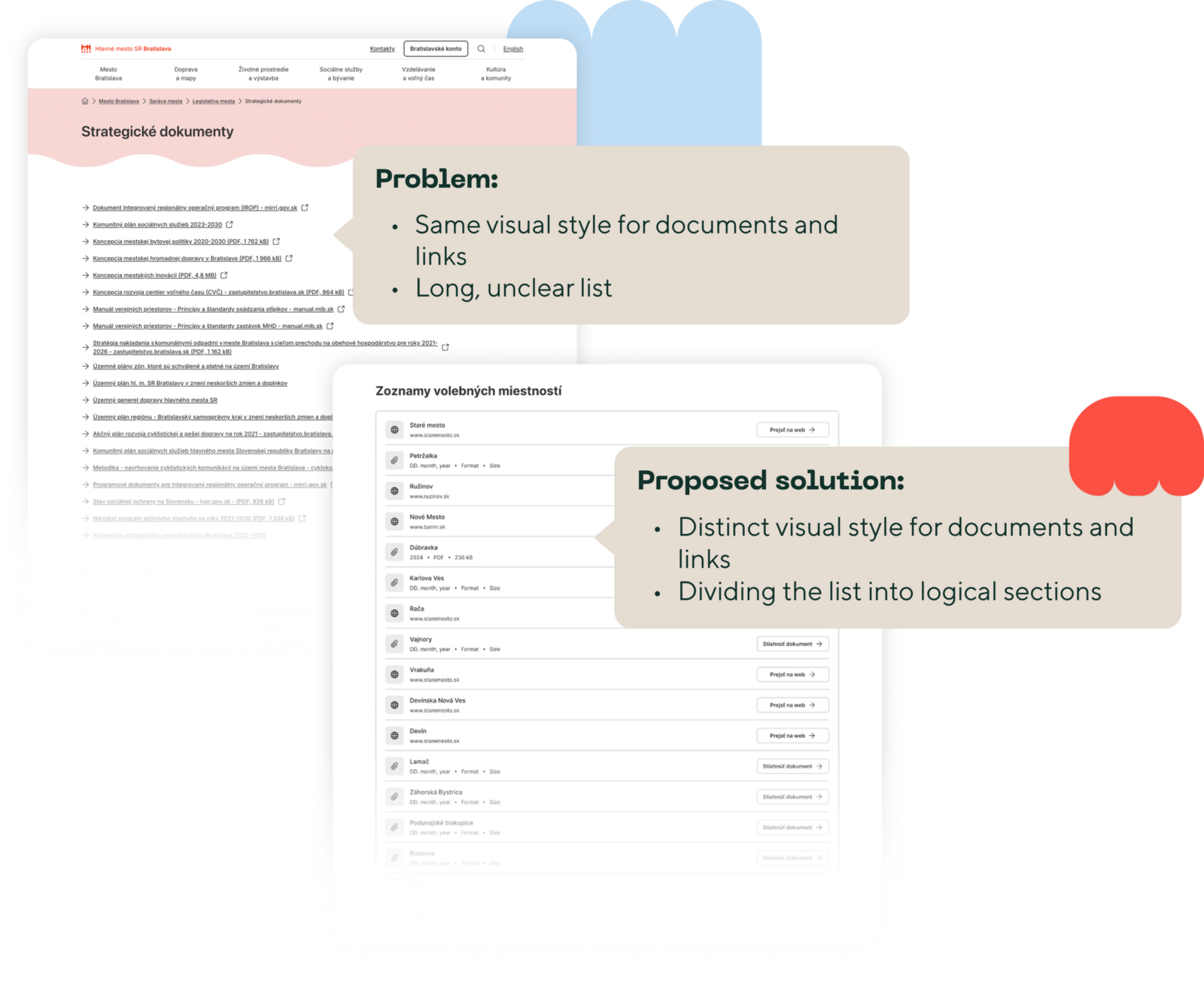
- User Orientation and Consistency: Instead of quickly resolving issues, residents had to search for information across multiple separate, visually inconsistent websites. This inconsistency and chaos led to repeated frustration and a decrease in the overall comfort of using city services.
- Overload of Operational Burden: If users did not find the necessary information quickly enough online (e.g., about waste, local taxes, or opening hours), they more frequently turned to other city communication channels, such as phone lines or personal visits. These situations only confirmed the importance of targeted optimization of the online environment as a key contact point between the city and its residents.
- Low quality of data and content: The content was gradually created across multiple sections and platforms, leading to the occurrence of duplicates, varying levels of updates, and a less uniform way of presenting information. As a result, users did not always have a clear and quickly accessible answer to their question.
- Accessibility barriers: Although the city's websites performed relatively well in terms of accessibility, there were still critical areas. Small deficiencies in design elements did not comply with the highest accessibility standards WCAG 2.2 AA. These barriers excluded citizens with visual or other disabilities from fully utilizing the services.

Human-Centered Design a UX Governance
Our role has gone beyond the scope of a design supplier. We act as a consulting and educational partner for digital development, impacting 500,000 residents of the capital city. Our approach is based on the principles of human-centered design and UX governance.
1. Unification of the design system
We started with the unification and refresh of the design system. It wasn't just about colors and fonts. We created universal elements and rules for consistent communication across selected websites of the City Hall and its organizations. We addressed the issue: How to integrate organizations (STARZ, OLO) with their own strong identities into a unified structure without having to give up their brand.
2. Information Architecture for the User
We have designed a new conceptual plan for information architecture, outlining how to work with content. We have implemented a logic that limits the creation of duplicate and redundant content. We propose a transition from an administrative structure to a service-oriented structure (e.g., transitioning from "categories" to clear, compact cards with direct actions).
3. UX Consultations and Workshops
Through regular UX consultations and workshops, we not only identify pain points in services but also actively educate the City Hall staff. We teach them to create content that is designed for user needs, not for internal administration, thereby increasing the digital maturity of the entire organization over time.
4. Inclusive Design
Equality of access to public services was a priority. In our consultations and design, we focused on accessibility, proposing adjustments to key UI elements to strictly meet the standards of WCAG 2.2 at level AA.
Collaboration that transforms the city into a better place
Collaboration with Bratislava, the Capital City of Slovakia, has shown us that even complex systems in public administration can be transformed into solutions that serve people. Our main task was and is to transfer our expertise in the field of UX and provide them with a clear vision that simplifies the lives of 500K of residents. Together with the City of Bratislava, we are building a digital future where online communication is efficient, transparent, and human-oriented.
Qualitative benefits and expected impact
- Reduction of operational load: Unified, logical IA and functional search should lead to a significant decrease in inquiries at the call center and reduction of manual administration.
- Consistent user experience: Citizens will no longer be confused by inconsistency. All online interactions will meet the same standards.
- Increase in digital inclusion: Thanks to accessibility, online services will become fully available even to users with limitations, reinforcing the principle of equal access to public information and services.
- Data-driven decision making: By organizing the content structure, conditions are created for better analytics and data-driven decision making on priorities in service development.