
More than half of Czech customers have already used AI when selecting or purchasing a product. For e-shops, this means a new challenge: How to ensure that ChatGPT, Gemini, or Perplexity recommend their products?
Visibility in AI is gradually becoming another space where brands compete for customer attention. However, the rules are a bit different than with classic SEO. It's not enough to rank high in Google's results. AI assistants work with product feeds, reviews, comparison sites, website content, and other sources from which they compile recommendations.
Why do AI still overlook most Czech e-shops, what determines product recommendations, and how can brands improve their visibility? We discussed this with Vojtěch Oravec, founder and CEO of Ranketta, a company specializing in measuring and optimizing product visibility in AI assistants. Vojtěch previously worked in the research team of Tomáš Mikolov, the author of the word2vec algorithm, and for his work in AI-driven commerce, he received the Discovery of the Year award at the Czech Online Expo.
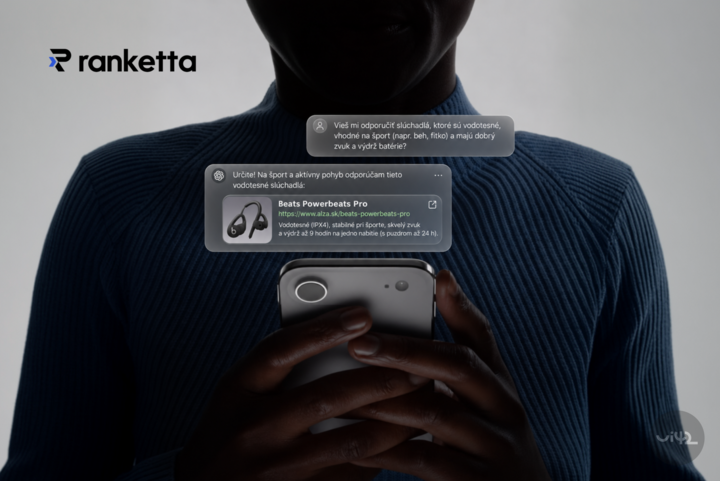
AI is changing the way customers choose products
ui42: To start, introduce us to Ranketta. Who do you help and with what?
Vojtěch Oravec: The reason for Ranketta's creation is quite simple. People today commonly ask Google AI or ChatGPT what to buy and which product AI would recommend. However, companies had no way of knowing if their products even appeared in these responses. Available tools didn't cover this, and manual checking wasn't enough.
That's why we created a platform that measures the visibility of brands and individual products (SKU) in AI assistants. We track how often and in what context AI recommends products, and at the same time, we help optimize product data so that AI can process it better.
We monitor all the big players - ChatGPT, AI Overviews, AI Mode, Perplexity, Gemini, Claude, Copilot, and Grok.
Our typical customer is an e-shop or brand that sells products directly to customers. This includes, for example, dietary supplements, cosmetics, electronics, or sports equipment, categories where people often ask AI for advice.
The second group consists of agencies that want to measure and report AI visibility to multiple clients at once.
ui42: According to the E-commerce Barometer 2026, which we prepared at ui42 together with Ipsos, 51.9% of Czech respondents used AI in the last six months when choosing or purchasing. However, only 22.3% trust AI recommendations. How do you explain this difference?
Vojtěch Oravec: We don't see this as a contradiction. Rather, it shows what people use AI for today: to get oriented, narrow down their choices, and compare products. However, they often verify the final decision elsewhere - and AI itself often sends them there.
In our data from October 2026, based on Czech questions monitored for clients, Google AI Mode cited Heureka in 10% of responses and Perplexity Zboží.cz even in 17%.
For e-shops, this complicates measurement. In the same period, AI cited the brand's website in only 48% of responses where the brand was mentioned. This varies significantly depending on the assistant. Perplexity adds a link in 73% of cases, ChatGPT in 63%, while Gemini and Google's AI Mode approximately in 40%.
In other cases, the customer learns about the brand but may reach the website through another route, appearing in analytics as direct entry or organic traffic.
For an e-shop, this implies two tasks. First, it must make it into the shortlist that AI offers to the customer. Then it must stand up to verification. Therefore, the price, parameters, and ratings must match on the e-shop, Heureka, and in the Merchant Center feed.
What determines which products AI recommends?
ui42: How do ChatGPT, Gemini, or Perplexity choose the products they recommend to the customer?
Vojtěch Oravec: Each AI assistant searches for information a little differently. Google's shopping answers - AI Mode, AI Overviews, and Gemini - are based on the Shopping Graph, which also reflects feeds from the Merchant Center. It's the same export with prices and availability that e-shops use for shopping ads. ChatGPT and Perplexity, on the other hand, read the web more: product pages, comparators, marketplaces, or reviews.
We also see differences in Czech data. In October 2026, Perplexity cited Zboží.cz in 17% of responses, Google AI Mode Heureka in 10%, and ChatGPT Heureka in about 5%. If you're missing on Zboží.cz, you have a worse chance in Perplexity. If you have poor ratings on Heureka, you may lose in AI Mode. Therefore, optimizing for just one assistant is not enough.
The basics are similar: the exact product name with parameters, price and availability, reviews, and mentions on other websites. GTIN, such as the EAN code, plays a significant role. It allows AI to link a specific product with reviews and comparisons elsewhere. Without it, it must pair only by name, which may not work reliably. Consistency in price is equally important. AI can take it from the feed or comparators, so it should be the same everywhere.
ui42: Why does AI completely skip some e-shops or their products in recommendations?
Vojtěch Oravec: It's usually not because AI evaluates the e-shop negatively. It simply doesn't know enough about it.
In our June 2026 study, we analyzed a million shopping questions. Of approximately 67,000 active Czech e-shops, only about 9% appeared in recommendations. The rest of the recommendations were divided among marketplaces and comparators.
One of the most common problems is GTIN. Among e-shops whose catalogs we have access to, GTIN is missing or incorrect in 77% of them.
The second problem is incomplete names. In 79% of e-shops where we record the size or color of the product, these data are missing in the name for at least a tenth of the variants.
Without GTIN, AI has a harder time pairing the product with reviews, and from a name like "Running Shoe Pro," it may not know which specific variant it is.
Another problem is content loaded only through JavaScript. According to Vercel's December 2024 analysis, OpenAI and Anthropic robots do not run JavaScript. Therefore, important information such as description, price, and parameters should be directly in HTML.
Finally, content that AI can use as a source is often missing: comparisons, guides, or answers to specific customer questions. These are worth creating based on what people actually enter into AI assistants.
Optimization for AI: What works and what is just a myth?
ui42: There is more and more talk about optimization for AI today. What recommendations do you encounter, even though the data doesn't confirm them?
Vojtěch Oravec: For example, the advice to add a llms.txt file to the web keeps repeating. However, according to available data, almost no one reads it.
Ahrefs' May 2026 analysis, which included approximately 137,000 websites, showed that the vast majority of these files were not accessed at all during the monitored period. Moreover, Google states in its official guide that llms.txt is not used for its AI functions.
The second advice is to divide texts into the smallest possible pieces and find the "ideal" paragraph length, as AI supposedly processes them better.
Google states that nothing like this is necessary, and there is no ideal page length. We don't have comparable confirmation for other assistants, so I see it more as an unconfirmed claim. Texts still make sense to write primarily for people.
The third notion is that simply adding structured data will automatically increase the number of recommendations in AI.
Ahrefs tracked pages that added them in 2026, and the number of citations in ChatGPT and AI Mode did not change significantly. This analysis has its limitations - for example, it tracked pages that AI already cited.
Therefore, I would certainly not remove structured data, as they have other uses, such as in enriched results in Google. Just don't expect a miracle from them.
How to measure visibility in AI and its impact on revenue?
ui42: How can an e-shop find out if AI visibility actually brings customers and revenue?
Vojtěch Oravec: Classic analytics only shows part of AI's impact. Clicks from AI Overviews and AI Mode are counted by GA4 into organic search, some visits from apps may be recorded as direct entry, and about half of the mentions according to our data do not contain a link at all.
For e-shops with connected GA4, only about 2.4% of traffic came from AI assistants in October 2026 compared to organic.
However, these visits have higher value. For a typical e-shop from our sample, traffic from AI converts about a third better than organic - the median conversion rate was 2.61% compared to 1.98%.
At the same time, it brings about a fifth higher revenue per visit. We recorded better conversion from AI in 68% of e-shops for which we had enough data. However, this does not apply universally, and for some e-shops, AI lags behind organic.
Therefore, we recommend monitoring for specific products and AI assistants how often the product appears in responses, in what position, and what share of recommendations it gains compared to the competition.
The impact on money then needs to be pieced together from multiple sources. In GA4, set up the AI Assistant channel, monitor the development of your brand's search, and you can add a simple question to the order process: "Where did you hear about us?"
ui42: Do you have a specific example of an e-shop or brand that has significantly improved its visibility in AI?
Vojtěch Oravec: One example is BrainMarket, a Czech e-shop with healthy nutrition, dietary supplements, and natural cosmetics. Its average position in AI responses improved from about sixth to third place. In some categories, such as berberine or ashwagandha, it appears in up to 44% of relevant responses. Year-on-year, its traffic from AI sources increased by 143%, and revenue from this traffic by 145%.
A similar shift is seen outside of e-commerce. Slovak CloudTalk, which provides a cloud phone platform, approximately doubled its AI visibility to 38.7% over two months - from May to June 2026. Its website cloudtalk.io became the most cited domain in the questions it monitors.
The most helpful thing was that the team knew which pages AI already cited and could update them first.
Where to start with optimizing an e-shop for AI?
ui42: What would you recommend to an e-shop that wants to improve its visibility in AI? What can be managed in the first month, and what requires long-term work?
Vojtěch Oravec: I would start with what you can measure and what can be relatively cheaply fixed.
In the company, someone should be responsible for this topic who can connect e-commerce, product data, and marketing - for example, an e-commerce lead - along with the person responsible for the product feed.
In the first month, it is usually possible to add GTIN at least for the best-selling products and check the feed in Merchant Center. A rejected product may not appear in Google's shopping answers. At the same time, it's worth verifying that the main content is directly in the page code, and for key products, add a clear description of what they are for and who they are suitable for.
Then set up measurement. I wouldn't evaluate individual changes from day to day - results vary between questions, so it's more reasonable to look at the development at least approximately weekly.
Long-term work involves content and reputation. This includes comparisons, guides, and tests created according to real customer questions, but also reviews on Heureka or mentions in media and expert websites. AI composes its recommendations from such sources, and results can therefore manifest over months.
At Ranketta, we also offer a free audit, which only requires a work email and domain. We'll show how often the e-shop appears in AI responses, who is ahead in the category, and which areas make sense to address first.
How do Ranketta and ui42 complement each other in improving AI visibility?
ui42: Ranketta can identify problems with product visibility in AI. Who actually implements the proposed changes? How do you complement each other with an agency like ui42 in this regard?
Vojtěch Oravec: At Ranketta, we do two main things: we measure the visibility of specific products and propose adjustments to their data.
Our agent can modify names, descriptions, GTIN, and parameters, and for each change, it indicates the level of certainty. You can approve changes individually or set a threshold from which the agent will execute them automatically. The client decides what is ultimately published.
Approved adjustments are then sent to sales channels like Merchant Center, Heureka, Zboží, or Amazon through product feeds. We also have direct connections with Shopify and Shoptet. The advantage is that we don't have to interfere with the original product catalog of the e-shop.
The rest of the work naturally belongs to the agency. This includes developing and programming custom web solutions, correctly implementing structured data, creating articles based on questions identified by Ranketta, working with feeds, or campaigns.
It's similar with ChatGPT Ads. At Ranketta, we have a beta feature that shows whether and how often ads in a given category are displayed and whether a specific brand's ad appears among them.
We measure this area, but the agency would handle the actual campaigns.
Such a connection makes the most sense for e-shops with a larger catalog that don't have sufficient internal capacities for development or content. With a smaller number of products and their own team, much of the basics can be managed internally.
What does the interview imply for e-shops?
AI is not the new Google. It's another place where purchasing decisions are made.
The advent of AI assistants doesn't mean that classic search, comparators, or reviews stop being important. Quite the opposite. AI draws from these sources and combines them into a response that can significantly influence the customer's next step.
Therefore, for e-shops, it's not just another discipline with a new acronym. The customer's path to the product is primarily changing. Part of the decision-making that used to happen between search results, product pages, and comparators can now start with a single question asked to ChatGPT, Gemini, or Perplexity.
The foundation remains very practical: having quality and consistent product data, being present in the sources AI draws from, and measuring whether assistants actually recommend you for relevant questions.
Want to know how AI sees your e-shop?
With the web, content, and product data adjustments that the audit reveals, we can help you at ui42.
Ranketta is a platform for optimizing agentic commerce. It monitors how AI assistants like ChatGPT, Perplexity, or Google AI Mode recommend products across ten AI models at the brand and individual product (SKU) level. It can enrich product data from which AI draws and send approved changes back to sales channels via feeds or direct connection without overwriting the e-shop's catalog.