Custom E-shop vs. SaaS Solution: When is Custom Development Really Worth It?
What does it mean
Choosing an e-commerce platform is among the most important technological decisions a company makes. On one side are SaaS solutions, which allow launching an online store quickly and with relatively low initial investment. On the other side is a custom-made online store, which offers greater flexibility, control, and the ability to tailor the technology to the specific needs of the business.
For many years, custom development was the domain of the largest players. However, the advent of artificial intelligence, automation, and personalization once again raises the question of whether now is the right time to invest in a custom solution.
More info
The Trap of Mediocrity: Why Boxed Solutions Hit Limits in the AI Era?
SaaS platforms like Shopify, Shoptet, or other cloud solutions have revolutionized how easy it is to launch an e-shop. Their advantages include quick deployment, low initial costs, and a plethora of ready-made functionalities.
The problem arises when a company starts to grow.
It needs:
- advanced integrations,
- custom processes,
- personalization,
- AI solutions,
- specific customer scenarios.
And this is where the difference between a rented platform and a custom solution becomes apparent.
When Everyone Has the Same AI, No One Has a Competitive Advantage
Most modern SaaS platforms today are adding AI features. Automatic product descriptions, content generation, recommendations, or chatbots are gradually becoming standard. This is good news for the entire market. However, it also means that the same features are available to the competition. A true competitive advantage does not arise from using AI. It arises from how you can integrate it with your own processes, data, and customer experience.
This is where a custom e-shop gains a significant lead.
Limits of Plugin Solutions vs. AI Integrated Directly into Business Logic
Many SaaS platforms address new functionalities using plugins or third-party applications. For simple scenarios, this works very well. However, if you want to create your own AI recommendation system, intelligent shopping assistant, or automation based on specific company data, you often encounter technical limitations. With a custom development approach, AI is part of the system's architecture itself, not an add-on that you try to connect additionally.
Data Sovereignty: The Greatest Wealth Under Your Control
In digital business, data is the most valuable asset. Information about customers, purchasing behavior, products, or logistics today determines how effectively a company can use AI, automation, or personalization. This is why data sovereignty is increasingly being discussed.
Why Are Own Data a Competitive Advantage?
Every AI model needs quality inputs.
The better you know your customers, the more accurately you can:
- recommend products,
- personalize communication,
- optimize marketing,
- predict future behavior.
With a custom solution, you have full control over the data and can use it precisely according to your needs.
Security and Privacy in the Era of AI Agents
Companies today are increasingly deploying AI agents that work with internal data, orders, warehouses, or customer communication.
This naturally raises the question of security.
Own infrastructure allows:
- more precise access control,
- better data control,
- easier fulfillment of internal security requirements,
- greater transparency when working with sensitive information.
Especially for larger organizations, security is often one of the main reasons for custom development.
The Economics of Decision-Making: ROI of Custom Solutions in the Long Run
One of the most common arguments against custom development is the cost. Initially, the investment in a custom solution is indeed higher. However, when making decisions, it is necessary to evaluate the total costs over the project's lifetime, not just the initial investment.
The End of Hidden Fees and Revenue Percentages
Many SaaS platforms operate on a model of regular fees. For smaller projects, these are negligible amounts. However, for growing e-shops, they can gradually increase significantly.
The total costs often include:
- licenses,
- transaction fees,
- paid plugins,
- third-party integrations,
- additional performance limits.
With a custom solution, a company has significantly more control over what and to whom it pays.
Scaling Without Technological Boundaries
One of the biggest advantages of custom development is the ability to respond to new opportunities. If a new technology, AI model, or business model emerges, the company does not have to wait for the roadmap of a global provider. It can implement it immediately. This ability to quickly respond to changes is one of the greatest competitive advantages in 2026.
When to Stick with SaaS and When It's Time for a Custom E-Shop?
Not every project needs custom development. For many startup e-shops, SaaS is an ideal choice. It allows for a quick start and validation of the business model without a large investment. The tipping point comes when technology starts to limit growth.
Typical signals are:
- complicated integrations,
- high development costs,
- limits in personalization,
- increasing fees,
- problems with automation,
- limitations in deploying AI solutions.
That's when it's worth considering modernization.
How ui42 Approaches Custom E-Shop Development
At ui42, we do not see the decision between SaaS and custom development as a battle of two worlds. For some projects, Shopify makes sense. For others, BUXUS or a hybrid solution combining a stable core and custom modules. It is important to find an architecture that supports the future growth of the company, not hinders it. Therefore, when designing e-shops, we evaluate not only the current needs of the client but also their future plans in AI, automation, expansion, and scaling.
Technology should not be an obstacle to growth. It should be its accelerator.
Latest news

ChatGPT Ads are here, are you ready?


Who is a design engineer and what do they do? A discipline at the intersection of design and code


When to start preparing Christmas campaigns?


Strategic Digitization of a B2B Company 3/3: Digitization Roadmap for the CEO

Finax Case Study: Digital Transformation of an Investment Platform Built on User Research



Strategic Digitization of a B2B Company 1/3: Why AI is Not the First Step

Google Ads update August 17, 2026: why your performance may drop and how to prepare


Shopify is not the problem. The problem is the perceptions that circulate about it.

The number of steps in the cart does not determine the conversion of the e-shop. This does.
Contact us
Everything for the growth of your business in one place
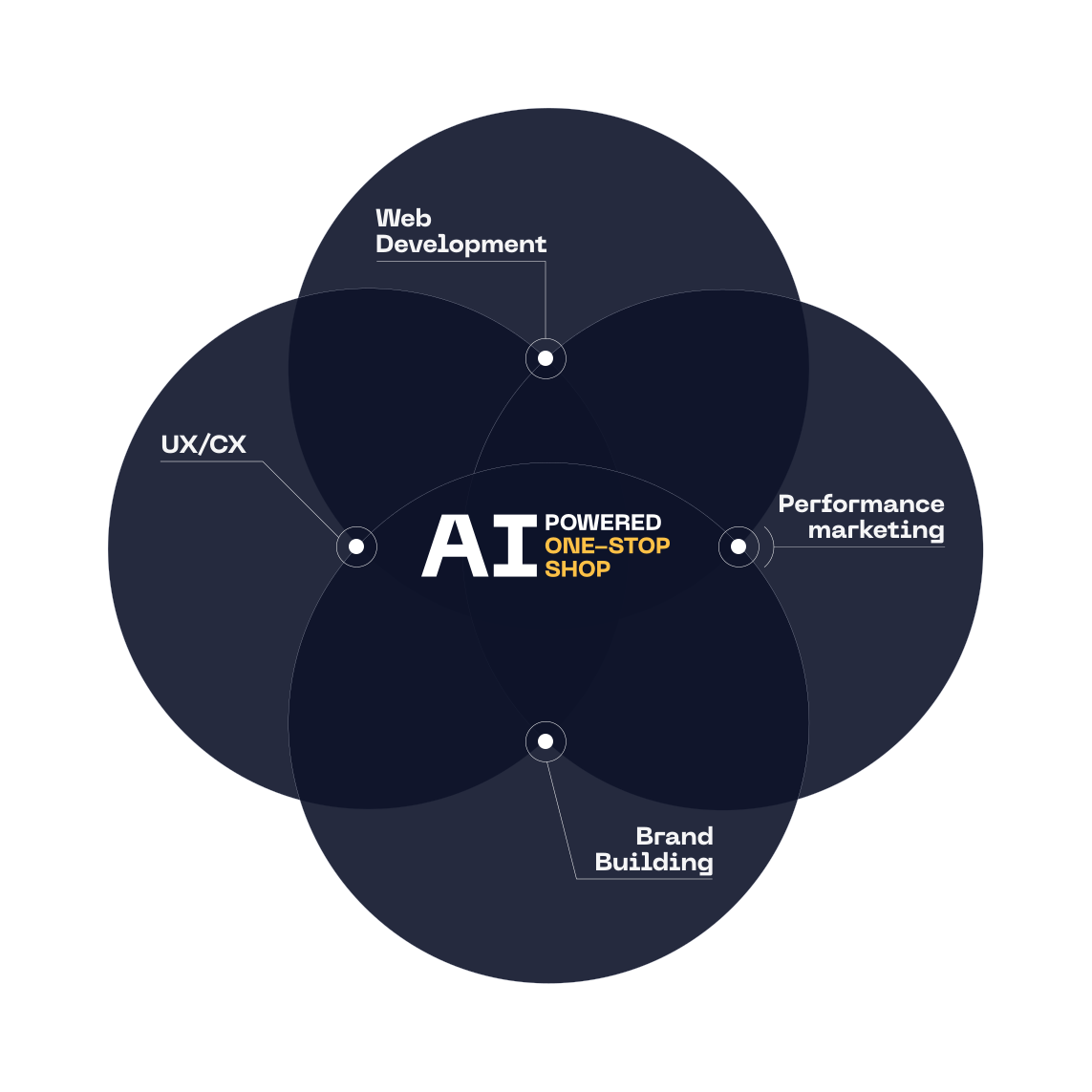
At ui42, we combine strategy, creativity, technology, marketing, and AI into one entity.
We build brands and visual identities, create websites and e-shops, design UX and CRO, create creative content, and deliver measurable results through performance marketing.
Our solutions are enhanced by FLUIDUM – ui42's AI intelligence, which transforms company data into a competitive advantage.
Thanks to this, you gain a partner who can cover the entire digital ecosystem of your business – from the first contact with the brand to conversion.
Don't miss out on the latest news from the world of UX, programming, analytics, and marketing.

Thank you for subscribing!

Get a free consultation
What do you need help with?
Select all options that apply to you
The form has been sent successfully.