How to measure website visibility in AI responses? New metrics in Bing Webmaster Tools
Veronika VerešováWhat does it mean
For many years, classic SEO reporting relied on two basic indicators – the position of the page in search engine results and the number of clicks from organic search. However, this perspective is becoming incomplete.
An increasing portion of searches today occurs in the environment of AI responses. In the era of zero-click, the user no longer needs to go through a list of results or visit a website. Instead, they receive an answer generated by artificial intelligence, which draws information from multiple sources and displays only a few citations.
That's why in June 2026, Microsoft expanded Bing Webmaster Tools with four new AI visibility metrics - Intents, Topics, Citation Share, and Compare. Their goal is not to replace traditional SEO metrics but to complement them with insights into how AI systems use your content when creating responses.
Let's take a look at what each metric measures, how to interpret them, and what can be gleaned from them.
More info
SEO Reporting in the AI Era: Why Tracking Only Positions and Clicks is No Longer Enough
Generative search operates differently from traditional search results. The AI model doesn't select a single link but creates its own response based on information from multiple websites, which it then cites as sources.
For SEO, this means a fundamental change. Visibility no longer depends solely on whether a page ranks in the top positions. It is increasingly important whether its content becomes part of the response the user receives.
How Organic Visibility Changes When Users Don't Receive a Traditional List of Results
If a user receives an answer directly from AI, organic visibility can no longer be assessed just by search engine positions or the number of clicks. It is equally important to know whether artificial intelligence used your content as a source.
In practice, this means that your website can be cited even for queries that would not bring any visits in traditional search. On the other hand, high organic positions do not automatically guarantee that your content will appear among the cited sources of an AI response.
This is why new AI visibility metrics are emerging. They complement traditional SEO reporting and help measure how often and on what topics your content appears in the responses of generative search engines.
Why Citations in AI Responses Are a New Signal of Brand Authority
In AI responses, grounding plays an important role - the process by which the model bases its response on specific web sources and cites them. If your content regularly appears among these sources, it is a strong signal that AI considers you a trustworthy source of information in that area.
Citations thus represent a new type of brand authority. They are not backlinks or positions in search results. They confirm that your content is of sufficient quality, relevance, and trustworthiness to become part of the response AI provides to users.
For companies, this is a new way of building expertise. The more often AI uses your content as a source, the stronger authority the brand creates not only with users but also within the generative search ecosystem itself.
What AI Visibility Insights Bring in Bing Webmaster Tools
The original AI Performance Report, introduced by Microsoft at the beginning of 2026, answered a simple question – in which AI responses was your content cited across Microsoft Copilot, Bing, and selected partner AI environments.
The new AI Visibility Insights go significantly further. In addition to the citations themselves, they help understand on what topics you appear, what intent users had, what share of citations you receive, and how these data evolve over time.
All four metrics are currently available in preview mode.
Intents: Understanding User Intent
The search query itself often does not provide enough information about what the user was actually looking for. This is why Microsoft introduced the Intents metric, which groups grounding queries by their intent.
Categories include, for example, Informational, Commercial, Navigational, Research, Learn and Solve, Creation, or Local.
Thanks to this, you no longer just see a list of questions where your content was used. You also gain better context. An e-shop can find out that AI most often uses its content for shopping or comparison queries, while a professional magazine will dominate in research or educational questions.
This information helps better plan content and adapt its structure to what user needs it actually covers.
Topics: AI No Longer Works with Keywords, but with Topics
Traditional SEO has long been based on individual keywords. However, generative search works differently. AI models think in broader concepts and thematic contexts.
The Topics metric therefore connects related queries into thematic clusters.
Microsoft cites examples such as solar panels, solar energy efficiency, or residential solar installation. Although these are different searches, AI groups them under the common topic Solar Energy.
For SEO teams, this is a much more natural view of content. Instead of tracking hundreds of individual keywords, they can analyze entire thematic areas, identify content gaps, and better understand where they are building authority.
However, it should be noted that Topics and Intents are based on AI classification. Since this is still a preview version, some topics may still be relatively general in specialized areas.
Citation Share: How Much Space Your Website Gains in AI Responses
The number of citations indicates how often your content appears in AI responses. Citation Share goes a step further and shows what share of all citations for a specific query was attributed to your website.
It's not enough to know that you were cited. It's also important to know how much space you gained among other sources.
Thanks to this metric, you can more easily identify topics where AI considers you a strong source of information, as well as areas where you share attention with a larger number of other websites.
However, it is important to correctly interpret the results. Microsoft warns that Citation Share is not a new ranking or content quality score. It is an observational metric that describes the current state of citations. It does not compare competitors, does not represent a share of traffic, and does not guarantee future visibility.
Compare: Tracking the Development of AI Visibility Over Time
The latest innovation is the Compare metric, which allows you to easily compare different periods.
You can, for example, view the last 30 days compared to the previous month or compare your own time intervals.
Such a comparison helps reveal whether AI visibility improved after publishing new content, after modifying existing pages, or due to seasonal changes.
When interpreting the results, however, it is important to remember that AI responses are influenced by many factors. In addition to the content itself, these include model changes, information currency, competition, and changing user behavior.
How SEO Teams Can Use AI Metrics in Practice
New metrics are not just another report. They provide data that can influence content strategy and the way companies build their authority.
Identifying Areas Where You Are an Authority for AI
The combination of Topics and Citation Share helps reveal topics where AI regularly uses your content as a source. It also shows areas where your representation is weaker or fragmented.
Such insights help decide which thematic circles are worth further developing and where it makes sense to invest in new content.
Linking AI Citations with Content Strategy
If you combine these data with the Intents metric, you get an even more accurate picture. You no longer just see topics, but also the reason why users are looking for that information.
This allows for more targeted content creation. You will approach an article intended for research purposes differently than content aimed at supporting purchasing decisions.
In practice, this is a shift from optimizing for individual keywords to building topical authority, which AI systems can recognize and repeatedly use.
What These Metrics Don't Tell
Although this is a significant step in AI SEO reporting, they should not be interpreted as a new way of evaluating positions.
Citation Share is not a new SEO position or new ranking. It says nothing about content quality, does not provide information about traffic, and does not offer a view of the competition.
Its role is to help understand how AI works with your content, not to create another ranking to compete in.
Impact on E-shops and Corporate Websites
New metrics also have practical significance for companies that create product or advisory content.
Visibility of Product and Advisory Content
Using Intents and Topics, you can find out whether AI uses your content for shopping questions, product comparisons, or rather for expert guides and educational content.
For e-shops, this is valuable information. It shows whether advisory content really helps build authority and influences customer decision-making even before the actual purchase.
Higher Demands on Content Quality
Generative search engines choose sources they can trust. This means that even greater emphasis will be placed on expertise, clear structure, clear answers, and quality information architecture.
Superficial or generic content will have less and less chance of becoming part of AI responses.
How ui42 Can Help with AI-ready SEO Reporting
At ui42, we use AI agents FLUIDUM, who continuously monitor SEO and GEO (Generative Engine Optimization), track changes in visibility, and alert to new opportunities or performance declines. Thanks to this, we can respond to changes in AI search continuously and help clients build the long-term authority of their content.
Latest news

Phishing website: What to do when someone copies your e-shop?


How to verify an AI prototype before web development


Imunoklub Case Study: Unification of Two E-shops and More Value from Each Visit


ChatGPT Ads are here, are you ready?


Who is a design engineer and what do they do? A discipline at the intersection of design and code

When to start preparing Christmas campaigns?


Strategic Digitization of a B2B Company 3/3: Digitization Roadmap for the CEO

Finax Case Study: Digital Transformation of an Investment Platform Built on User Research


Strategic Digitization of a B2B Company 1/3: Why AI is Not the First Step
Contact us
Everything for the growth of your business in one place
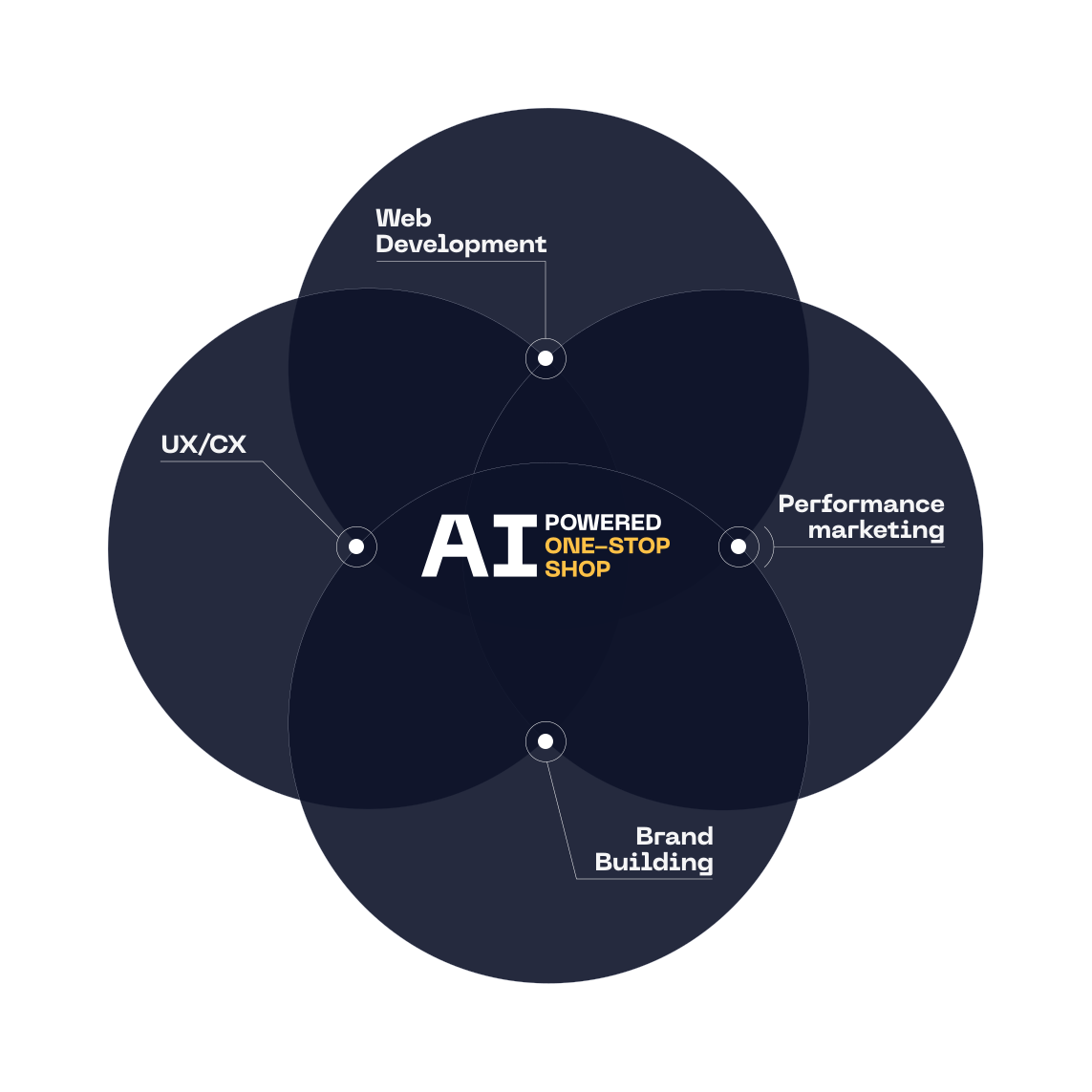
At ui42, we combine strategy, creativity, technology, marketing, and AI into one entity.
We build brands and visual identities, create websites and e-shops, design UX and CRO, create creative content, and deliver measurable results through performance marketing.
Our solutions are enhanced by FLUIDUM – ui42's AI intelligence, which transforms company data into a competitive advantage.
Thanks to this, you gain a partner who can cover the entire digital ecosystem of your business – from the first contact with the brand to conversion.
Don't miss out on the latest news from the world of UX, programming, analytics, and marketing.

Thank you for subscribing!

Get a free consultation
What do you need help with?
Select all options that apply to you
The form has been sent successfully.