What is Shopify?
What does it mean
Shopify is a cloud-based e-commerce platform for creating, operating, and growing online stores. It allows you to manage products, orders, customers, payments, inventory, sales channels, and analytics all in one place.
Since it is a cloud solution, the merchant does not need to operate their own e-commerce infrastructure. Shopify provides the technological foundation of the platform and its ongoing updates, while the specific e-shop can be tailored to the needs of the brand and business.
Shopify is used by smaller e-shops, growing brands, and large international companies. Depending on the project's needs, it is possible to start with a simpler solution or create a complex custom e-shop on Shopify with its own design, functionality, and integrations.
More info

How does Shopify work?
Shopify provides the technological foundation needed to operate an online store. After creating a store, you can manage products, orders, customers, inventory, content, and other parts of online sales through the administration.
The appearance of the online store is based on Shopify themes, which can be customized. For simpler projects, an existing theme with minor modifications may suffice. For more complex requirements, it is possible to create a custom design and functionality or connect Shopify with other systems.
The resulting solution, therefore, does not have to be just a ready-made online store from a template. Shopify can be the technological foundation for a custom online store tailored to the specific processes and requirements of the company.
What does Shopify offer?
Product and order management
In Shopify's administration, you can manage products, variants, collections, prices, orders, customers, and inventory. You can thus manage the online store from a single environment.
Custom design and online store modifications
Shopify offers ready-made themes that can be further customized. For demanding projects, the design and user interface can be custom-made according to the brand's needs.
Customization options can be further expanded with custom development and applications.
Payments and checkout
Shopify provides tools for managing checkout and supports multiple payment methods. The specific available payment options also depend on the country in which the online store operates.
Inventory management
Shopify allows you to track product inventory and work with multiple locations. Online and brick-and-mortar sales can also be connected through Shopify POS.
Sales on multiple channels
You don't have to sell products only through the online store itself. Shopify allows you to connect the online store with other sales channels and, through Shopify POS, also with brick-and-mortar sales.
International sales
Shopify includes tools designed for sales in multiple markets. Online stores can thus tailor their offerings to different countries and customer groups.
However, when expanding internationally, it is also necessary to consider content localization, payments, shipping, taxes, prices, and other specifics of individual markets.
Marketing and analytics
Shopify provides its own reports and analytical tools and can also be connected with other marketing and analytical platforms.
Merchants can thus track sales, orders, customers, and other data needed to evaluate the performance of the online store.
Shopify App Store
The functionality of the online store can be expanded using applications from the Shopify App Store. These cover areas from marketing and analytics to shipping and order management to customer support or process automation.
For more complex projects, it is also possible to create custom applications and integrations according to the needs of a specific business.
Automation with Shopify Flow
Part of the ecosystem is also Shopify Flow, a tool for process automation.
Using the trigger-condition-action principle, you can create workflows that automatically respond to events in the online store. Flow can help, for example, with working with orders, customers, products, or inventory.
Can Shopify be customized?
Yes. Shopify is not limited to choosing a ready-made template and uploading products.
Depending on the project's needs, it is possible to customize the design, create a custom theme and functionality, work with applications, or connect Shopify with other company systems.
For more complex projects, a custom online store on Shopify can be created, which uses Shopify's technological foundation, but the user interface, functionality, and integrations are tailored to the specific business.
What can Shopify be connected with?
Shopify offers an API and an extensive ecosystem of applications, allowing it to be connected with other tools and systems.
Depending on the specific project, this may include:
-
ERP and inventory systems,
-
CRM,
-
accounting systems,
-
payment solutions,
-
carriers and fulfillment,
-
marketing tools,
-
analytical platforms,
-
customer support,
-
product feeds and other sales channels.
For complex integrations, it is important to design not only the technical connection but also which system is the source of individual data and how they should be synchronized between systems.
Who is Shopify suitable for?
Shopify can be suitable for smaller online stores, growing D2C brands, as well as larger companies and international e-commerce projects.
When choosing a platform, it is therefore more important than the size of the company to assess its specific needs – required functionalities, integrations, markets, sales method, internal processes, and plans for further growth.
For a simpler project, the speed of launch and the existing Shopify ecosystem can be an advantage. For a demanding project, Shopify can become the foundation for a custom-designed e-commerce solution.
What is the difference between Shopify and a custom online store?
Shopify and a custom online store do not have to be two opposing options.
Shopify is a platform on which a custom online store can also be built. The difference lies mainly in the scope of customization.
A simpler Shopify online store can use an existing theme and ready-made applications. In a custom solution, the design, functionality, integrations, and user experience are designed according to the specific needs of the company.
If the standard options of the platform are not enough or the company needs specific business logic, an alternative may also be developing a custom online store on another technological foundation.
Summary
Shopify is a cloud-based e-commerce platform that provides the technological foundation for creating, managing, and developing an online store. It combines product, order, customer, and inventory management with tools for payments, analytics, marketing, automation, and sales through other channels.
Its advantage is the ability to start with a relatively simple solution and gradually expand it using applications, integrations, and custom development. Shopify can thus be the foundation of a simple online store or a complex e-commerce solution tailored to the needs of a growing brand.
Latest news

Phishing website: What to do when someone copies your e-shop?


Imunoklub Case Study: Unification of Two E-shops and More Value from Each Visit


ChatGPT Ads are here, are you ready?


Who is a design engineer and what do they do? A discipline at the intersection of design and code


When to start preparing Christmas campaigns?


Strategic Digitization of a B2B Company 3/3: Digitization Roadmap for the CEO


Finax Case Study: Digital Transformation of an Investment Platform Built on User Research


Strategic Digitization of a B2B Company 1/3: Why AI is Not the First Step

Google Ads update August 17, 2026: why your performance may drop and how to prepare

Contact us
Everything for the growth of your business in one place
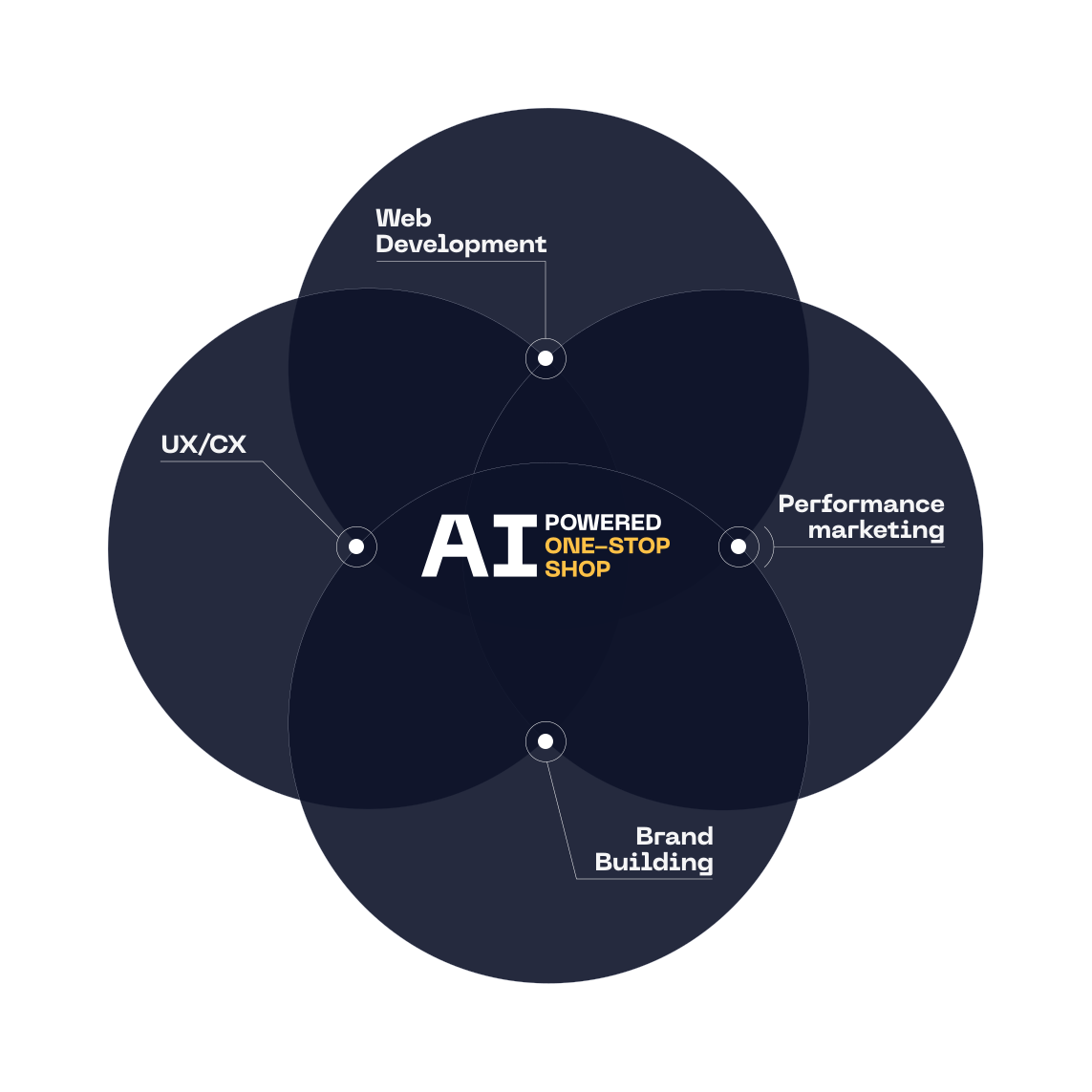
At ui42, we combine strategy, creativity, technology, marketing, and AI into one entity.
We build brands and visual identities, create websites and e-shops, design UX and CRO, create creative content, and deliver measurable results through performance marketing.
Our solutions are enhanced by FLUIDUM – ui42's AI intelligence, which transforms company data into a competitive advantage.
Thanks to this, you gain a partner who can cover the entire digital ecosystem of your business – from the first contact with the brand to conversion.
Don't miss out on the latest news from the world of UX, programming, analytics, and marketing.

Thank you for subscribing!

Get a free consultation
What do you need help with?
Select all options that apply to you
The form has been sent successfully.