Advertising on Meta has changed so dramatically over the past few years that most marketers are still playing by rules that no longer apply.
Behind this change is Andromeda, the new AI brain directly in Meta Ads, which has completely rewritten the way ads are distributed. And along with it, the role of the marketer has also changed.
The Revolution of Social Media Advertising Over the Last 10 Years
Let's start with two comparisons:
- In 2015, there were 2 million advertisers on Meta
- Today, there are 10 million.
This means a fivefold increase in competition over ten years. And since the advertising space in the newsfeed does not grow at the same pace as the number of people competing for it, the consequence is mathematically inevitable: CPM grows by 14% year-on-year, and investments in online marketing have increased by 73% year-on-year.
For a Meta specialist, this means that what brought a ROAS of 6 five years ago may not even be enough for a ROAS of 2 today. Not because they have worsened. But because the quality bar has risen.
What is Andromeda in Meta Ads?
Andromeda is an AI system that decides on four key things in real-time on Meta: who sees the ad, which creative, when, and where. Marketers often fear it because they feel they have lost control.
However, Andromeda is not an enemy. It is a magnifying glass that highlights every campaign weakness faster than ever before. The algorithm only amplifies the quality of inputs, and if the input is bad, the result will be bad and also expensive. Trash in, trash out.
Andromeda Influences Ad Performance
Meta used to optimize everything primarily towards conversion. Today, it optimizes for the entire user experience:
- ad relevance for a specific person
- user behavior before and after the ad
- ad experience, not just whether they purchased, but whether they liked the ad
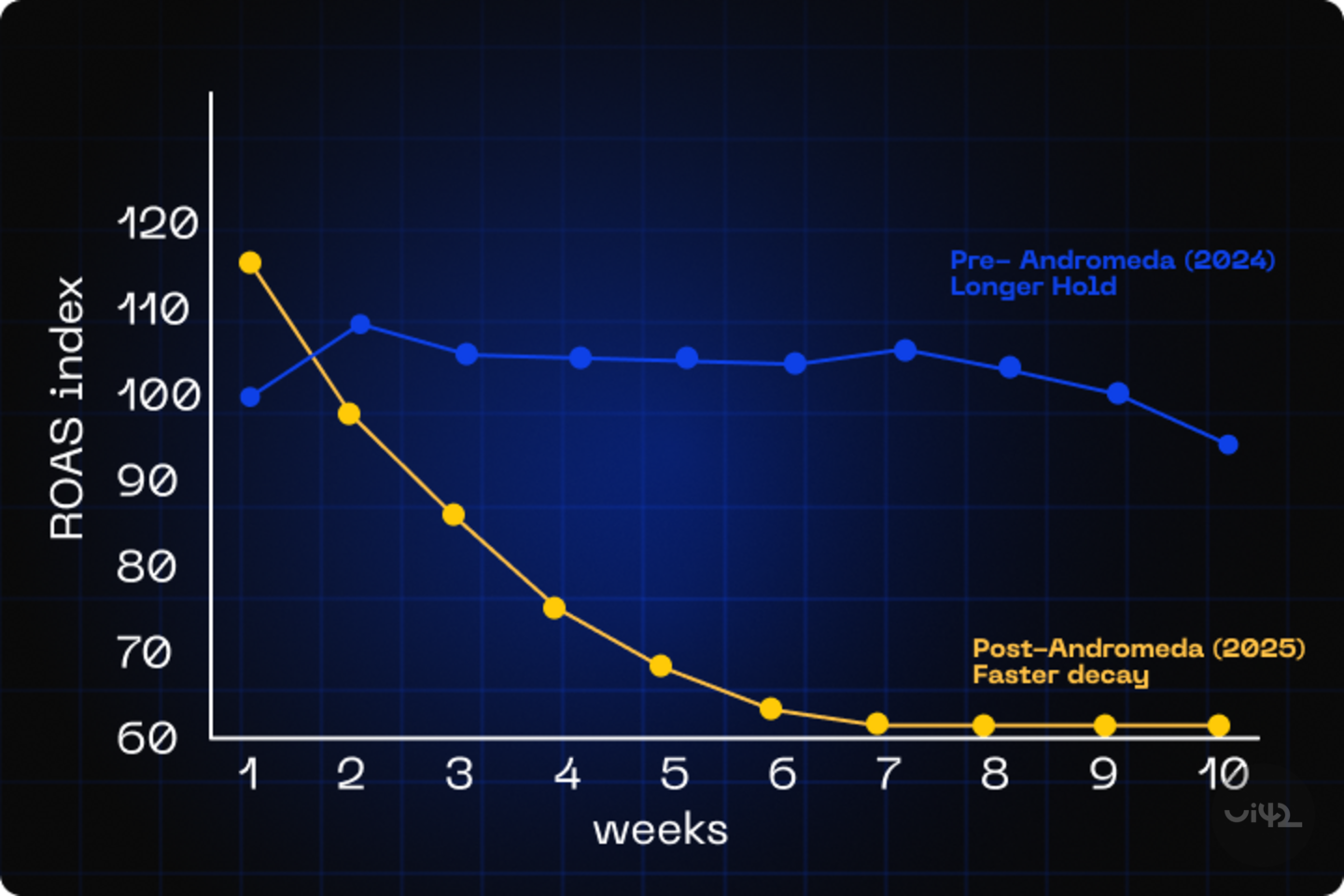
The algorithm no longer looks for the best ad. It looks for the most relevant ad for a specific person at a specific moment. And it's important to remember that what had the best ROAS last week may not work at all today.
So how do you create ads on Meta Ads?
What Determines Ad Performance Today
In Meta ads today, three factors determine the success of a campaign:
- Authenticity - an ad that looks like an ad loses to content that looks natural. UGC videos, native content, authentic situations, people instead of stock photos. This is the natural language of both the algorithm and users today.
- Diversity - different formats, hooks, stories, perspectives
- Volume of Creatives - the algorithm needs material to work with.
When it comes to diversity, most marketers still make the same mistake. They create three variants of the same ad. They change the product, background color, text, and think they have diversity. For the algorithm and the user, it's the same ad.
True diversity looks different. The same product through three completely different stories. A conversational carousel that looks like a screenshot of mobile messages, a video with a humorous hook, or a UGC video shot by a customer.

Different formats, different hooks, different tone. You reach the same customer in three ways, and the algorithm chooses the one that works.
And in terms of volume? The reality of most accounts looks similar, 1 campaign, 3 ads. Successful accounts contain 20–50 creatives. Three ads mean three attempts. More creatives give the algorithm more opportunities to find the right person at the right moment.
Less is More (But Only in Structure)
One of the biggest paradoxes of today's Meta marketing: there should be a lot of creatives, but the campaign structure should be simple.
If you do:
- overly sophisticated targeting (narrow segments instead of broad audience),
- manually fine-tuning placements,
- intervening in the campaign daily,
you will destroy the algorithm's learning. Every intervention resets optimization. And without 2–5 conversions a day, the campaign will never properly learn who to target.
Give the algorithm space and resist the temptation to constantly tweak things. The algorithm has its own path, and if you try to suppress it, you're only working against yourself.
Andromeda Also Monitors What Happens on Your Website
An ad does one thing, it brings people to the website where the purchase happens.
And Andromeda works with this. It doesn't stop at the click on the ad, it also monitors what happens after the click on the website: time on page, scroll, interactions, bounce rate. If you send people to a slow, confusing, or untrustworthy website, the algorithm notices, and it often results in higher CPM and worse performance.
The New Role of a Meta Ads Marketer
Today, a large part of the technical setup is done automatically by Meta itself. The algorithm decides who sees the ad, which creative is chosen, where it is shown, and how the budget is allocated.
Martin Madeja, PPC Team Leader ui42:
Today, the role of the marketer shifts more towards strategy. Understanding the customer, finding a strong message, coming up with creative ideas, and clearly communicating why the customer should choose your brand over ten other competitors they see every day.
Three Takeaways from This Article
- Creativity is the new targeting today - Meta finds the audience based on the quality and relevance of your ad.
- Diversity beats variations - different stories and formats work better than ten versions of the same ad.
- Successful Meta Ads today rely more on strategy, creativity, and the website than on the campaign setup itself.
Are Your Meta Campaigns Fully Utilizing Andromeda?
Or is the algorithm working more against you today?
If you want to find out where your campaigns are losing performance, whether Meta is receiving the right signals from your creatives, or why costs are rising without better results, contact us. We would be happy to take a closer look at your campaigns.