If you want to quickly increase traffic and sales, Google Ads is among the most effective online marketing tools. Unlike SEO, which delivers results gradually, PPC advertising can bring customers practically immediately.
The question, however, is not just whether to use Google Ads, but especially how and when it makes the most sense - especially for e-shops.
What is Google Ads (formerly Google AdWords)?
Google Ads is the largest advertising system on the internet. It allows you to display ads to people exactly at the moment when they are searching for, watching, or considering a purchase.
It operates on the principle of PPC (Pay Per Click). This means you don't pay for the ad display, but only when a user clicks on it.
At first glance, it sounds simple. I pay for a click and get a visitor.
In reality, there's much more behind it.
It depends on:
- who the ad is shown to,
- what keywords,
- and whether the click turns into a real customer.
And this is where the difference between average and high-performing PPC advertising begins.
How does Google advertising work in practice?
When a user enters a query into Google, an auction takes place in a fraction of a second. All advertisers who are trying to appear for the given keyword enter this auction.
However, the one who pays the most does not automatically win. Google also considers the quality of the ad, relevance, and the state of the website. Therefore, it may happen that even with a lower budget, you achieve better results if your campaigns are set up correctly.
The ad is not only displayed in search results. It can appear:
- directly in Google results,
- on partner websites,
- in mobile apps,
- or on YouTube.
However, data is crucial from the first moment.
Without measurement, Google Ads today makes no sense. Therefore, it is essential to have properly set up Google Analytics 4 and conversion tracking. Only then can you know whether the ad brings orders or just traffic without conversions.
Types of campaigns: From search to Performance Max
Google Ads offers several types of campaigns, and each has its place in e-shop marketing.
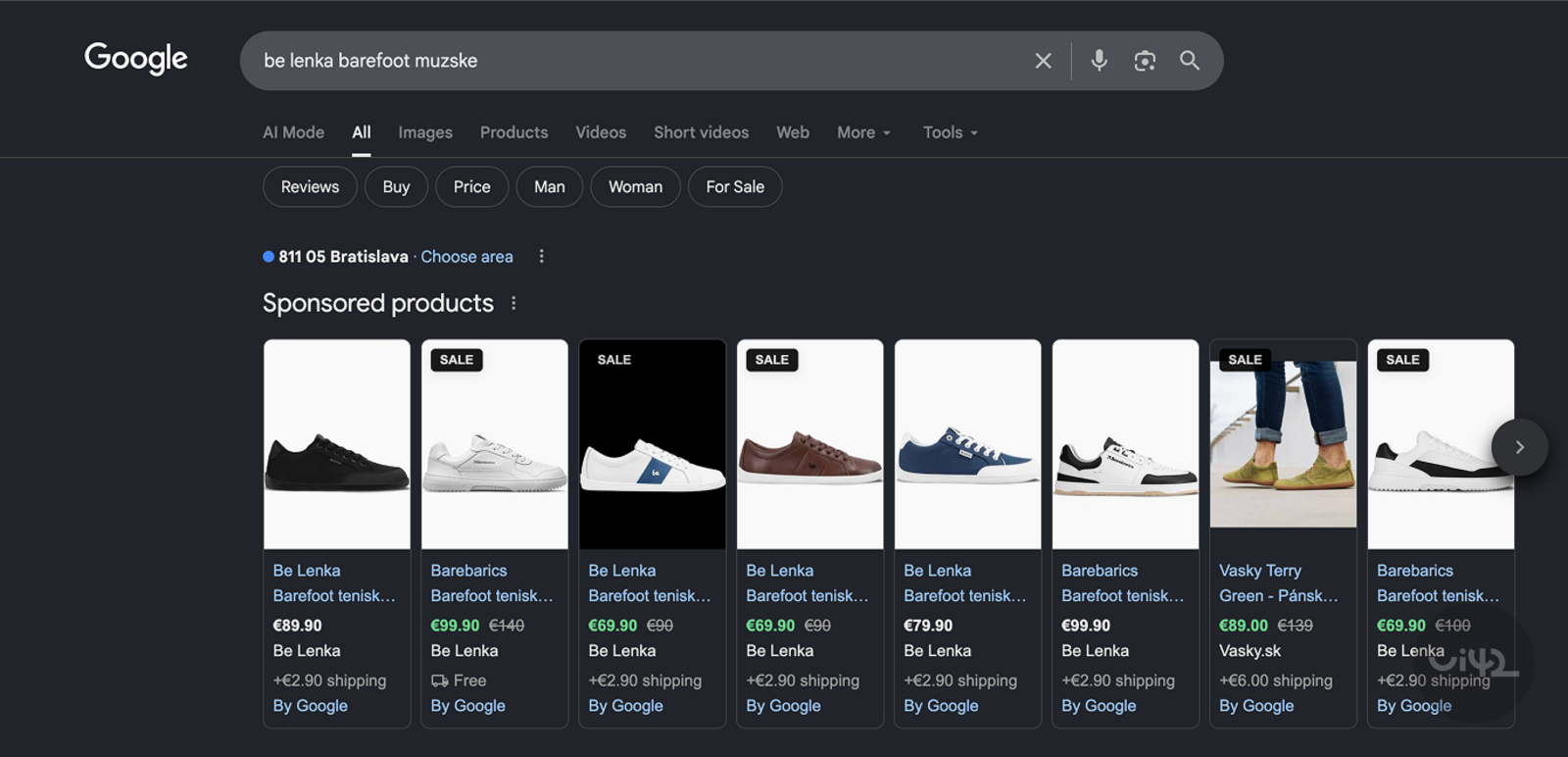
Google Shopping Ads
This type of ad displays products directly in search results, including price, image, and name. The user thus sees a specific offer even before clicking - which significantly increases the quality of traffic.
Banner advertising and remarketing
Remarketing also plays an important role. It allows you to reach people who have already visited your website but did not purchase. You remind them through banner ads or other formats, increasing the chance of completing a purchase.
Performance Max
This format uses Google's artificial intelligence and displays ads across all channels - from search to YouTube. Properly set up, they can significantly simplify campaign management and improve performance.
And it is precisely the combination of different types of campaigns that makes Google Ads a truly effective tool.
Cost of Google advertising: How much to prepare?
One of the most common questions is: how much does Google Ads advertising cost?
The answer is not universal. The cost operates on the principle of PPC (you pay per click). The price per click depends on several factors:
- competition in the given segment,
- the quality of your ads,
- the relevance of the landing page,
- and overall account optimization.
In practice, this means that two e-shops in the same segment can have completely different costs while achieving different results.
Therefore, the important thing is not how much you pay per click but how much CPA (cost per acquisition) is. In other words, how much a customer costs you.
When do you need a Google Ads agency?
Practically anyone can set up Google Ads today. The question is whether that's enough.
In smaller projects or when testing, "self-management" may make sense. But the moment you start investing larger budgets, efficiency comes into play.
And that's where the difference between trial-and-error and professional management shows.
What does a PPC specialist do?
- optimizes campaigns based on data,
- tests different approaches,
- reduces the cost per conversion,
- and connects advertising with the overall marketing strategy.
They don't just look at clicks but at results.
Performance growth thanks to ui42
Google Ads can deliver quick results.
But only when it is set up correctly. And even better, when you have the assurance that nothing is missed.
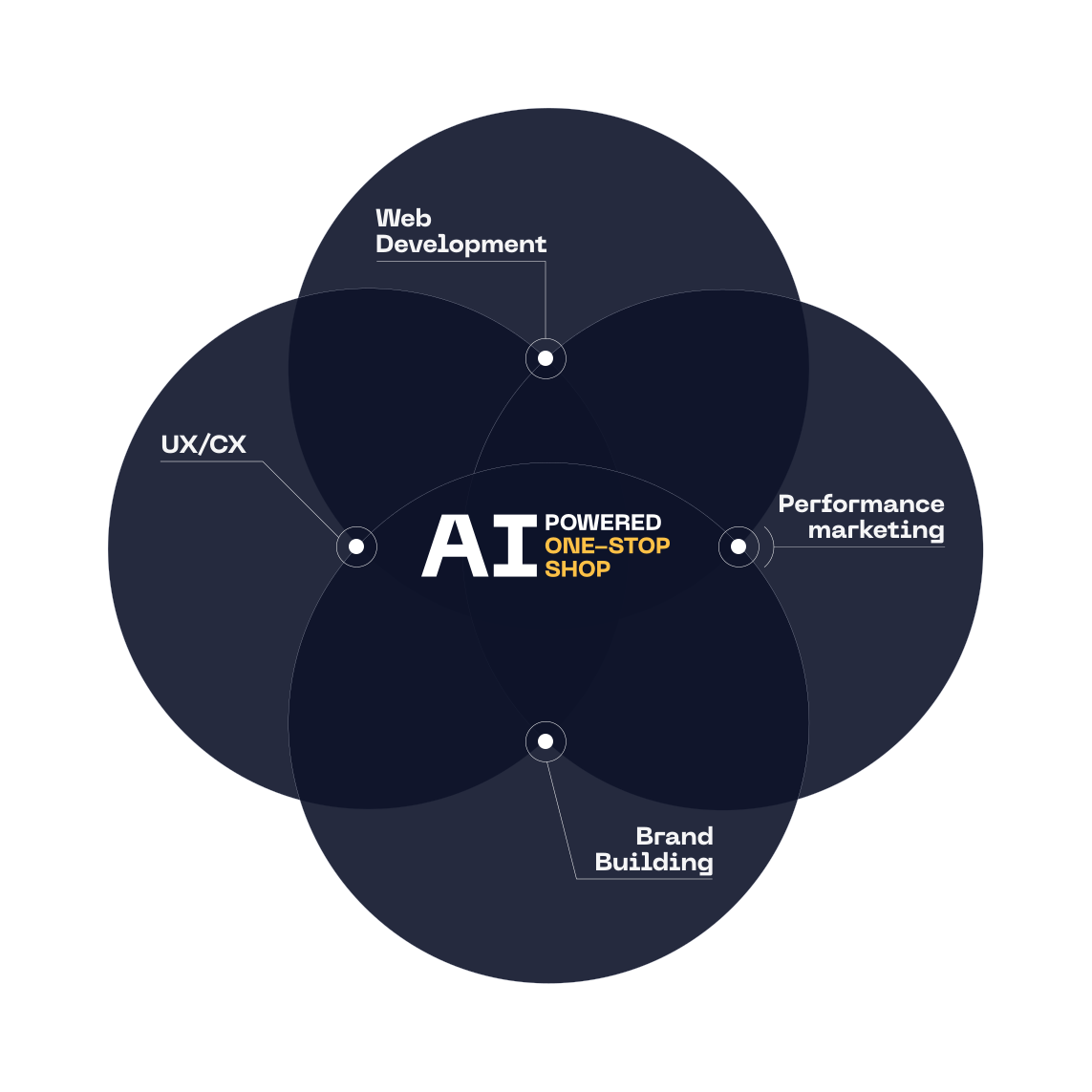
At ui42, we don't just follow the classic path of campaign management. We have Google Ads, analytics, and user behavior under constant supervision by our AI agent, which acts as our internal watchdog, monitoring the performance of your campaigns 24/7.
It monitors data across accounts, evaluates deviations, and alerts to problems before they affect results. Thanks to this, we can quickly respond to inefficient spending, conversion drops, or weak points in the purchase process.
We also connect PPC with UX, analytics, and CRO (conversion rate optimization). Because bringing visitors is not enough. The site must be ready to convert them into customers.
And that's the difference between advertising that just spends the budget and advertising that actually delivers results.