SEO website migration: Why organic traffic may not recover even after 90 days
What does it mean
Website migration or e-shop migration is among the most risky interventions from an SEO perspective. It is often said that the drop in organic traffic after migration lasts about three months and then everything returns to normal.
However, the reality is different.
An analysis by the agency SALT, which monitored 1,052 domain migrations, showed that only about a quarter of websites returned to their original level of organic traffic within 90 days. The median recovery time was 304 days, and some websites did not reach their original results even after a year.
This does not mean that migration is a bad decision. It only means that success does not depend on the mere transfer of the website, but on how it is prepared and managed.
More info
Why Website Migration is More Than Just Technical URL Redirects
Migration is often perceived as a technical task – 301 redirects are prepared, URLs are redirected, and the new website is launched.
From Google's perspective, however, migration is a much more complex process. The search engine needs to understand the website's structure anew, transfer authority from old URLs to new ones, re-index content, and verify that the new website provides the same value as the original.
What Happens to Organic Traffic After Domain Transfer or Redesign
A drop in organic traffic is natural during migration. Google needs time to process 301 redirects, re-index pages, and transfer authority signals.
However, the important thing is how long this state lasts. According to SALT data, only about 27% of migrations recover within 90 days, while the typical return of organic traffic takes about ten months.
Why Google Needs Time to Re-understand the New Website Structure
Google creates its own model for each website – it knows its structure, internal linking, and the authority of individual pages.
This model is disrupted by migration. If the domain, URL structure, content, and design are changed simultaneously, the search engine must re-evaluate a large part of these signals. The more changes occur at once, the longer the entire process takes.
What the Data Shows: Only a Portion of Migrations Recover Within 90 Days
The biggest misconception in SEO migrations is the expectation that success can be assessed after just a few weeks.
How Real Recovery is Measured Compared to Technical Proxy Metrics
After migration, technical metrics are often monitored – the number of indexed pages, ranking of selected keywords, or the number of crawled URLs.
However, these data do not indicate whether the migration achieved its goal. The true indicator of success is the return of organic traffic to pre-migration levels, not just technically correct indexing.
Why It's Important to Work with Baseline Traffic Before Migration
Without reference data, it is impossible to objectively evaluate whether the migration was successful.
Before launching the new website, it is advisable to create a baseline of organic traffic, ideally as a multi-month average supplemented by seasonality. Only then can the website's actual development be accurately assessed after migration.
When to Address That Migration is Not Progressing Correctly
A short-term drop in traffic is natural. However, if the situation does not begin to stabilize after several weeks or the decline continues to grow, it is time for a technical audit.
The sooner issues with indexing, redirects, or crawling are identified, the greater the chance of faster recovery.
Most Common Reasons for Slow SEO Recovery
Most problems after migration do not arise from one major mistake but from a combination of several smaller shortcomings.
Incorrect or Incomplete 301 Redirects on a Large Scale
Redirects are easily checked on smaller websites. However, for large e-commerce sites with thousands of URLs, it often happens that some pages remain without redirection or are directed to the wrong target.
Each such error means a loss of authority that Google cannot transfer to the new page.
Redirect Chains, Orphan Pages, and Loss of Internal Linking
Common problems also include redirect chains, i.e., multiple redirects of a single URL, which slow down crawling.
Equally dangerous are orphan pages – pages that have no internal link after the redesign. Google gradually stops considering them important, which can negatively affect their search positions.
Too Many Changes at Once: Domain, URL, Content, Design, and Structure
The biggest risk is when everything changes at once during a single launch – domain, URLs, information architecture, content, and design.
Each of these changes represents a separate SEO risk. If combined into one project, their impact multiplies, and it is much harder to determine what caused any drop in traffic.
Crawl Pressure During Migration: Why Googlebot May Slow Down
Migration changes not only the website but also the way Google crawls it.
Crawl Capacity Limit: Server Capacity, Responses, and Errors
During migration, Googlebot visits the website intensively. If the server responds slowly or returns errors, Google reduces the crawling intensity, which can significantly prolong the entire process.
Crawl Demand: Why Google Crawls Old and New URLs Simultaneously After Migration
After migration, Google simultaneously checks old URLs and new pages. Suddenly, it has to process twice the number of pages, which naturally increases the demands on the crawl budget and server infrastructure.
How Sitemaps, Logs, and Search Console Re-verification Help
A properly prepared XML sitemap, re-verification of the website in Google Search Console, and analysis of server logs can significantly help Googlebot navigate after migration.
As a result, new URLs get indexed faster, and the risk of unnecessary errors during crawling is reduced.
How ui42 Approaches Safe Website or E-shop Migration
We do not perceive migration as a one-time launch but as a process that begins even before the new website is deployed and continues for several months after its launch.
SEO Checklist Before Launch, During Launch, and After Migration
We divide each project into three stages – preparation, launch, and post-launch monitoring.
Before migration, we prepare a complete SEO audit, check redirect mapping, create a baseline of organic traffic, and verify internal linking. During the launch, we monitor the correctness of redirects, indexing, and server responses.
Monitoring Organic Traffic, Indexing, and Redirects After Launch
The project does not end after launch. We continuously monitor organic traffic, indexing, the status of redirects, and Googlebot behavior.
Our AI agents FLUIDUM continuously evaluate data from Search Console and analytical tools and alert to deviations before they significantly impact organic traffic.
When to Combine Migration with Redesign and When to Phase It
If the situation allows, we recommend dividing individual changes into multiple stages.
First, technical migration and only then redesign or significant content changes. This approach significantly reduces SEO risk and makes it easier to identify potential issues after launch.
Website migration does not have to mean a loss of organic traffic. However, it requires thorough preparation, a solid technical foundation, and systematic monitoring for several months after launch.
Latest news

Phishing website: What to do when someone copies your e-shop?


How to verify an AI prototype before web development


Imunoklub Case Study: Unification of Two E-shops and More Value from Each Visit


ChatGPT Ads are here, are you ready?


Who is a design engineer and what do they do? A discipline at the intersection of design and code

When to start preparing Christmas campaigns?


Strategic Digitization of a B2B Company 3/3: Digitization Roadmap for the CEO

Finax Case Study: Digital Transformation of an Investment Platform Built on User Research

Strategic Digitization of a B2B Company 1/3: Why AI is Not the First Step
Contact us
Everything for the growth of your business in one place
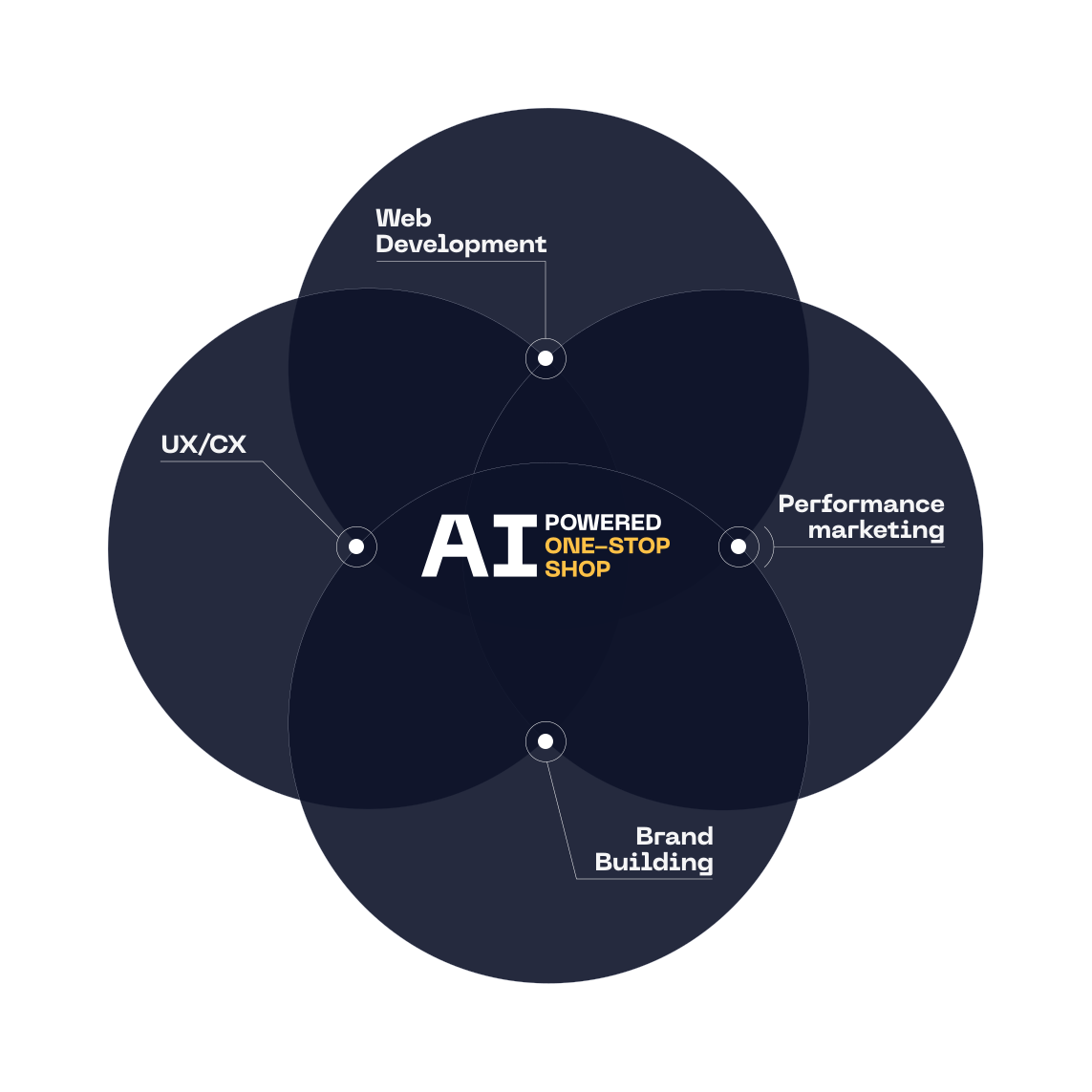
At ui42, we combine strategy, creativity, technology, marketing, and AI into one entity.
We build brands and visual identities, create websites and e-shops, design UX and CRO, create creative content, and deliver measurable results through performance marketing.
Our solutions are enhanced by FLUIDUM – ui42's AI intelligence, which transforms company data into a competitive advantage.
Thanks to this, you gain a partner who can cover the entire digital ecosystem of your business – from the first contact with the brand to conversion.
Don't miss out on the latest news from the world of UX, programming, analytics, and marketing.

Thank you for subscribing!

Get a free consultation
What do you need help with?
Select all options that apply to you
The form has been sent successfully.