The Future of E-commerce: Composable Architecture and AI Agents
What does it mean
Companies want to connect the e-shop with ERP, CRM, CDP, marketing tools, marketplace platforms, or AI agents. And it is precisely at this point that many traditional solutions begin to hit their limits.
Therefore, terms like Composable Commerce, microservices architecture, or headless CMS are increasingly being discussed. These are not technological buzzwords. They represent a new way of designing digital solutions that can grow alongside the business.
More info
Why is strategic flexibility more important than a fixed platform in 2026?
In the past, companies often chose an e-commerce platform with the aim of finding a one-size-fits-all solution. Product catalog, orders, marketing, content, and integrations were part of one system. Initially, it made sense. The problem arises when the company grows.
Suddenly, it needs better search, a new loyalty system, product recommendations using AI, or expansion into other markets. However, each change requires intervention into the entire system. This is where the so-called vendor lock-in arises – a situation where the company is technologically dependent on one platform, and every major change becomes complicated, expensive, or even impossible.
Modern e-commerce is therefore increasingly moving towards the opposite approach: instead of one platform, it uses multiple specialized tools that communicate with each other.
What is Composable Commerce?
The simplest way to explain it is through LEGO. Imagine you are building an online store. With a classic platform, you get one big set with fixed pieces. Some work great, others less so, but you have to use them all. Composable Commerce works differently.
You choose each part separately. For content, you can use one system, for search another, for personalization a third, and for AI recommendations a fourth. The result is not one big system, but an ecosystem of services that do exactly what they are intended for. Companies thus gain the ability to change individual components without having to rewrite the entire online store.
The end of the vendor lock-in era
One of the biggest advantages of the composable approach is independence. If a better tool for product search appears, you don't have to migrate the entire online store. You just replace the specific service. If you want to deploy a new AI model or AI agent, you don't have to wait for your platform to support it. Such flexibility becomes a strategic advantage. Especially in a time when technologies are changing faster than ever before.
MACH Architecture: Four Pillars of Modern E-commerce
Most modern composable solutions are based on the MACH concept.
The acronym stands for four basic principles:
- Microservices
- API-first
- Cloud-native
- Headless
These technologies today form the basis of modern custom development.
Microservices & API: When each part of the system does exactly what it should
In a traditional monolithic system, all functionalities are interconnected. Changing one part can affect the entire system. In a microservices architecture, each service operates independently. Search handles search. Payments handle payments. Personalization handles personalization. Individual services communicate with each other via API. The advantage is higher stability, easier updates, and faster development of new functionalities.
Cloud-native & Headless: Freedom without compromises
Equally important in modern solutions is the cloud-native approach and headless architecture. Headless CMS separates content from presentation. This means that the frontend and backend can be developed independently. The development team thus gains much greater freedom in designing the user interface, web performance, or customer experience. For the user, this means a faster web. For the company, faster development.
Composable Commerce as the Basis for AI Transformation
Many companies today invest in AI. They deploy chatbots, recommendation systems, or AI agents. However, they often encounter a problem that is not related to artificial intelligence, but to architecture. AI needs data. If data is scattered across different systems, unavailable, or poorly connected, the potential of AI remains untapped.
Why monolithic systems hinder AI
An AI agent needs to work with information about customers, products, warehouses, orders, or marketing campaigns. In older systems, this data is often locked in individual modules. The result is that AI exists, but does not have access to the information it needs to make decisions.
Data in motion
Composable architecture naturally solves this problem.
Since individual systems communicate via API, data can move between them in real-time.
The AI model can thus immediately respond to:
- price change,
- product availability,
- customer behavior,
- marketing campaign,
- or stock status.
That is why composable commerce is often referred to as AI-ready infrastructure.
Practical example: From search to AI shopping assistant
Imagine a customer looking for a winter jacket. A classic online store will display search results. However, an AI shopping assistant can work with purchase history, customer preferences, weather in their location, or current stock availability.
The result is not a list of products, but a recommendation tailored to a specific person. Such solutions, however, only arise in an environment where AI systems have access to data across the entire ecosystem.
When is it worth switching to Composable Commerce?
Not every company needs a composable architecture.
For a smaller online store, Shopify or a standard platform may be a more suitable solution.
The composable approach makes the most sense in situations where the company:
- is growing in multiple markets,
- needs complex integrations,
- invests in AI and automation,
- frequently changes functionalities,
- or encounters the limits of the existing solution.
In such a case, the higher initial investment is offset by lower costs for future development.
How ui42 builds future-ready online stores
At ui42, we do not see composable commerce as a goal, but as one of the tools for solving specific business problems. Sometimes the right choice is Shopify, other times BUXUS, and for complex projects, we design a modular architecture based on API and microservices. It is important that the technology supports the growth of the company, not restrict it.
That is why more and more e-commerce projects today are moving towards an architecture that is ready not only for further integrations but also for the advent of AI agents, automation, and new business models.
Latest news

ChatGPT Ads are here, are you ready?


Who is a design engineer and what do they do? A discipline at the intersection of design and code


When to start preparing Christmas campaigns?


Strategic Digitization of a B2B Company 3/3: Digitization Roadmap for the CEO


Finax Case Study: Digital Transformation of an Investment Platform Built on User Research



Strategic Digitization of a B2B Company 1/3: Why AI is Not the First Step

Google Ads update August 17, 2026: why your performance may drop and how to prepare


Shopify is not the problem. The problem is the perceptions that circulate about it.


The number of steps in the cart does not determine the conversion of the e-shop. This does.
Contact us
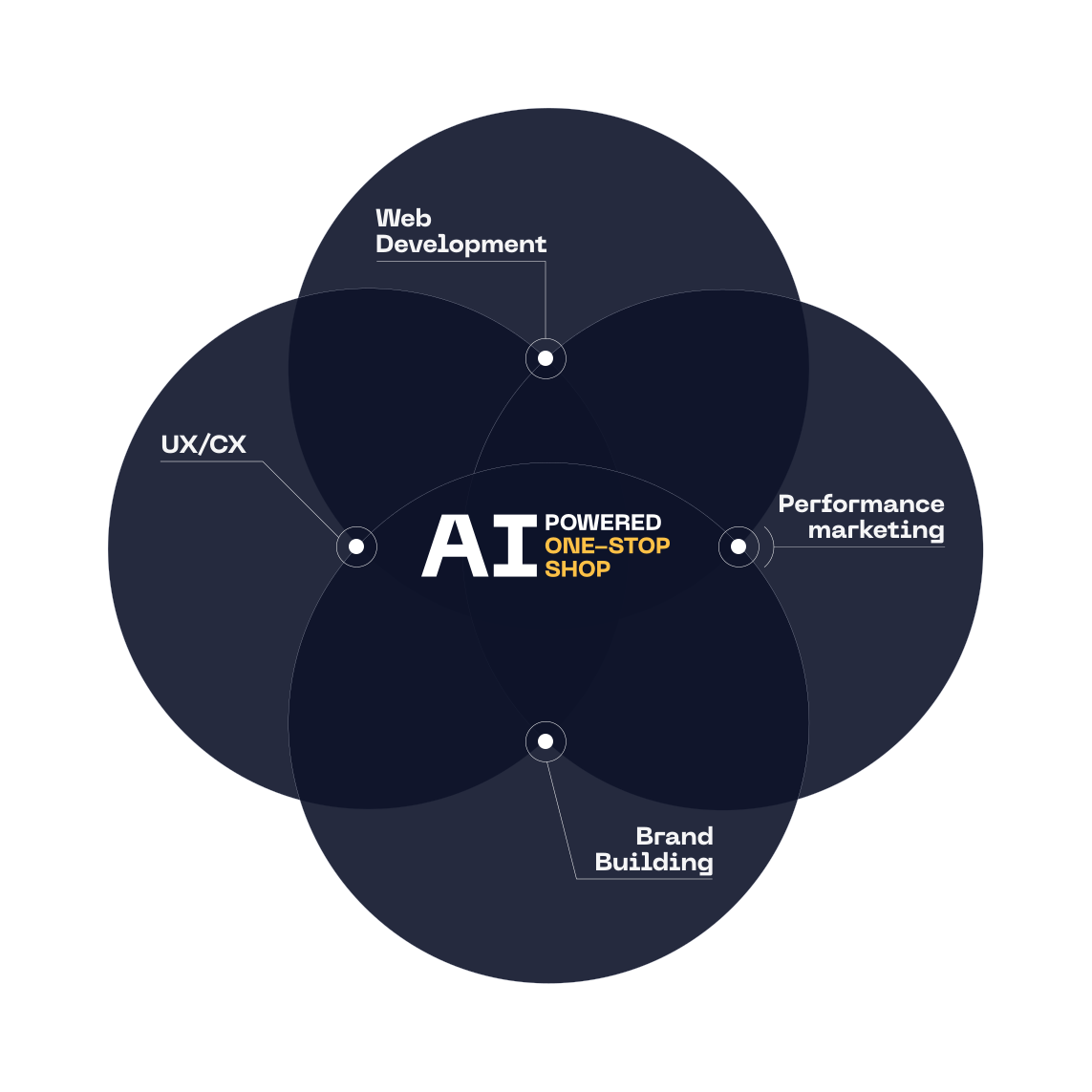
Everything for the growth of your business in one place
At ui42, we combine strategy, creativity, technology, marketing, and AI into one entity.
We build brands and visual identities, create websites and e-shops, design UX and CRO, create creative content, and deliver measurable results through performance marketing.
Our solutions are enhanced by FLUIDUM – ui42's AI intelligence, which transforms company data into a competitive advantage.
Thanks to this, you gain a partner who can cover the entire digital ecosystem of your business – from the first contact with the brand to conversion.
Don't miss out on the latest news from the world of UX, programming, analytics, and marketing.

Thank you for subscribing!

Get a free consultation
What do you need help with?
Select all options that apply to you
The form has been sent successfully.