What is edge rendering and how does it work?
What does it mean
Edge rendering is a method of generating web pages as close to the user as possible. Instead of rendering the page only on a central server, it is performed on edge servers distributed in various geographical locations.
The result is shorter server response time, faster page loading, and a better user experience, especially for globally available web applications.
Edge rendering is primarily used in modern frameworks and cloud platforms that allow application logic to run directly on distributed infrastructure.
More info
Edge rendering as a way to speed up web display
In traditional server-side rendering (SSR), each request goes to a central application server. If the user is on another continent, network latency can significantly extend the page load time.
Edge rendering solves this problem by moving part of the application logic to servers located closer to the user.
When a user opens a web page, the request is processed at the nearest edge node instead of a distant data center. This reduces the time needed to transfer data, and the user receives the resulting HTML page faster.
This approach is particularly suitable for applications with global traffic or for sites that need to combine dynamic content with low latency.
What is the difference between edge rendering, SSR, and static generation?
Although all three approaches address the delivery of HTML to the user, they differ in the place and time when the page is created.
| Approach | When HTML is created | Where it is executed |
|---|---|---|
| Static Site Generation (SSG) | during the build process | build server |
| Server-Side Rendering (SSR) | with each request | central application server |
| Edge rendering | on request or dynamically as needed | edge servers in CDN |
Static generation offers the highest performance for pages whose content does not change often. SSR allows generating personalized content with each visit. Edge rendering represents a compromise – it retains the benefits of dynamic rendering while reducing response time by performing calculations closer to the user.
Impact of edge runtime on speed and user experience
Edge rendering is closely associated with the term edge runtime, which is the environment where application code is executed on edge servers.
Unlike traditional server environments, edge runtime is designed for very fast execution of short operations with minimal latency. Typically, these are JavaScript or Web API compatible environments that allow processing requests without the need to communicate with a central server.
In practice, edge runtime can ensure:
- content personalization according to the user's region,
- website localization by language or country,
- authentication and redirections,
- A/B testing,
- dynamic modifications of HTTP headers or page content.
A well-designed edge architecture can reduce latency, speed up page loading, and positively affect Core Web Vitals metrics and overall user experience.
When is edge rendering worthwhile?
Edge rendering brings the greatest benefit to projects that serve users from multiple countries or need to quickly generate dynamic content without high response from the central server.
Conversely, for smaller presentation websites or pages with predominantly static content, static generation may be a more suitable solution, as it is easier to operate and manage.
The choice between static generation, SSR, and edge rendering therefore depends on the project's requirements for performance, content personalization, and global availability.
Latest news

Phishing website: What to do when someone copies your e-shop?


How to verify an AI prototype before web development


Imunoklub Case Study: Unification of Two E-shops and More Value from Each Visit


ChatGPT Ads are here, are you ready?


Who is a design engineer and what do they do? A discipline at the intersection of design and code

When to start preparing Christmas campaigns?


Strategic Digitization of a B2B Company 3/3: Digitization Roadmap for the CEO

Finax Case Study: Digital Transformation of an Investment Platform Built on User Research


Strategic Digitization of a B2B Company 1/3: Why AI is Not the First Step
Contact us
Everything for the growth of your business in one place
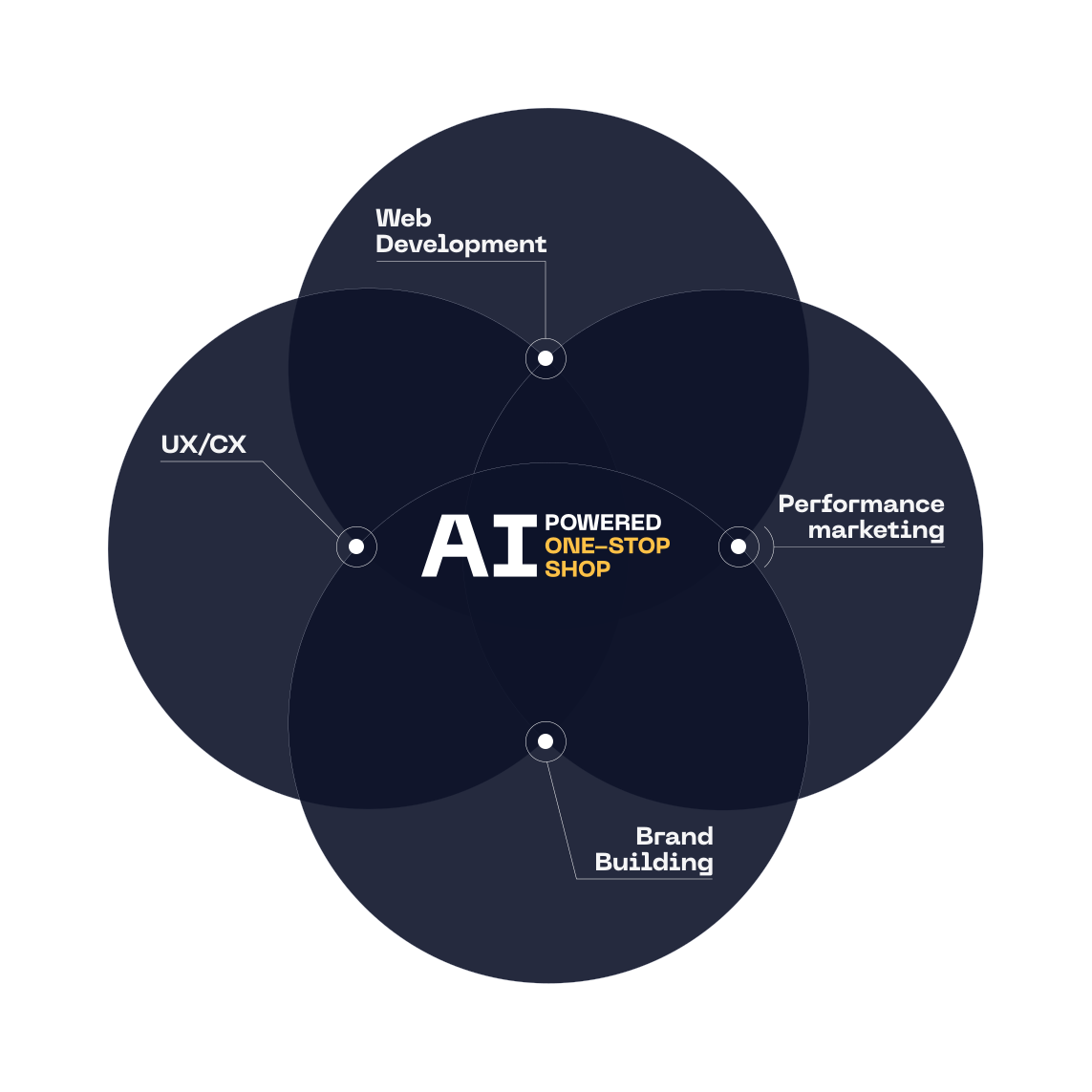
At ui42, we combine strategy, creativity, technology, marketing, and AI into one entity.
We build brands and visual identities, create websites and e-shops, design UX and CRO, create creative content, and deliver measurable results through performance marketing.
Our solutions are enhanced by FLUIDUM – ui42's AI intelligence, which transforms company data into a competitive advantage.
Thanks to this, you gain a partner who can cover the entire digital ecosystem of your business – from the first contact with the brand to conversion.
Don't miss out on the latest news from the world of UX, programming, analytics, and marketing.

Thank you for subscribing!

Get a free consultation
What do you need help with?
Select all options that apply to you
The form has been sent successfully.