Brand codes
Veronika VerešováWhat does it mean
What Makes a Brand Recognizable Even Without a Logo
Some brands you recognize instantly. Just a few words, a headline, or the way they explain something – and you know who's speaking. You don't need a logo, colors, or visuals. You recognize them by their language.
This ability is precisely backed by brand codes.
More info
What are brand codes?
Brand codes are repetitive meaningful and linguistic signals that a brand uses consistently in its communication. They can take the form of words, phrases, metaphors, attitudes, or the way a brand explains its value.
They are not slogans or one-time claims.
Nor are they general attributes like "innovative" or "reliable."
Brand codes answer the question:
How does a brand speak so that you recognize it even without visual elements?
Why brand codes are important
Without clearly defined brand codes, a brand's communication naturally slips into the generic language of the segment. Texts start using the same words as the competition, the same arguments, and the same promises. Not because they are bad, but because they lack a solid meaningful framework.
Brand codes give communication:
-
recognizability – the brand sounds different from others,
-
consistency – the same language across the web, products, and campaigns,
-
trust – repetition of meanings creates a sense of certainty,
-
long-term value – a brand is built over time, not in a single campaign.
Brands with strong brand codes do not have to constantly search for new words. On the contrary – they consciously repeat the right ones.
Brand codes are not tone of voice
One common mistake is to confuse brand codes with tone of voice. Tone of voice determines the mood of communication (friendly, formal, relaxed). However, brand codes determine the meaning.
Two brands can communicate in a friendly manner, but each uses different words, different metaphors, and a different attitude. These are brand codes.
Simply put:
-
Brand codes = what and why we say
-
Tone of voice = how we say it in a given situation
How brand codes are created
Brand codes do not arise from brainstorming slogans. They arise from a strategic decision about which words and meanings the brand "claims" – and which it avoids.
The process of creating them usually has three steps:
First, it is necessary to analyze the language of the segment. What words does the competition use? What terms are repeated everywhere? These words are often generic and do not differentiate the brand.
The second step is to identify linguistic generics – words that are safe but interchangeable. Quality, solution, future, innovation, technology. If they become the main meanings of communication, the brand blends in with the crowd.
Only the third step is the selection of own meanings. If the entire segment talks about the future, the brand can anchor itself in the present. If everyone communicates technology, the brand can talk about certainty, control, or simplicity that technology brings.
These decisions are then reflected in the brand codes.
What brand codes look like in practice
Brand codes manifest in:
-
which words are repeated on the website,
-
how the brand names benefits,
-
which metaphors it uses,
-
how it explains products and services,
-
what it never says.
They appear on the website in headlines, categories, product descriptions, CTA elements, and microcopy. In campaigns, they appear in claims, texts, and arguments.
Strong brand codes work across channels – without the need to constantly change them.
Brand codes as the foundation of brand writing
Brand writing is the practical application of brand codes into texts. Without them, copywriting is just a reaction to a brief. With them, it becomes systematic work with the brand.
If a brand has defined brand codes:
-
texts sound consistent even with different authors,
-
the website does not appear fragmented,
-
communication is recognizable even in details,
-
the brand builds its own linguistic space.
That is why brand codes are one of the most important, yet most underestimated tools for building a brand.
Brand codes are quiet but extremely powerful. They do not shout, but they shape how customers perceive the brand over time. If you want your brand to sound like a specific voice rather than a category, brand codes are where you should start.
Latest news

Phishing website: What to do when someone copies your e-shop?


Imunoklub Case Study: Unification of Two E-shops and More Value from Each Visit


ChatGPT Ads are here, are you ready?


Who is a design engineer and what do they do? A discipline at the intersection of design and code


When to start preparing Christmas campaigns?


Strategic Digitization of a B2B Company 3/3: Digitization Roadmap for the CEO

Finax Case Study: Digital Transformation of an Investment Platform Built on User Research


Strategic Digitization of a B2B Company 1/3: Why AI is Not the First Step

Google Ads update August 17, 2026: why your performance may drop and how to prepare

Contact us
Everything for the growth of your business in one place
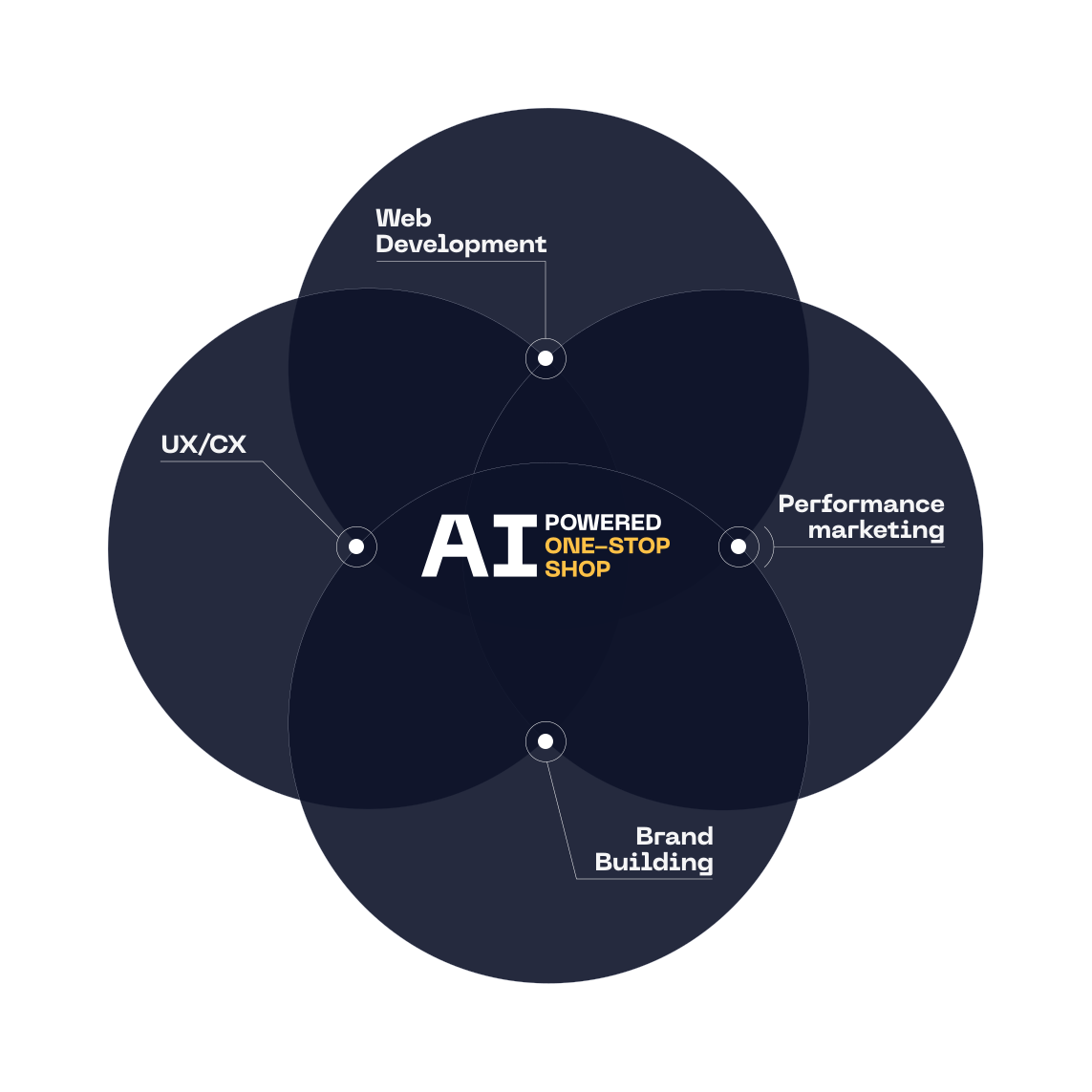
At ui42, we combine strategy, creativity, technology, marketing, and AI into one entity.
We build brands and visual identities, create websites and e-shops, design UX and CRO, create creative content, and deliver measurable results through performance marketing.
Our solutions are enhanced by FLUIDUM – ui42's AI intelligence, which transforms company data into a competitive advantage.
Thanks to this, you gain a partner who can cover the entire digital ecosystem of your business – from the first contact with the brand to conversion.
Don't miss out on the latest news from the world of UX, programming, analytics, and marketing.

Thank you for subscribing!

Get a free consultation
What do you need help with?
Select all options that apply to you
The form has been sent successfully.