Just a few years ago, CRO was mainly about whether the user notices the button, where we move it, and what color we give it. Today, the reality is different. Most websites are technically fine, fast, responsive, and clean in design. Despite this, people hesitate, postpone decisions, or leave without converting. Not because they don't know how to click, but because they are unsure if they want to click.
This is where CRO fundamentally changes in 2026. From interface optimization, it becomes decision optimization. We are no longer just looking for the answer to the question "what do people do," but especially "why don't they do it."

Richard Káčer, CRO Specialist ui42: "The biggest mistake of current CRO is that we try to optimize the visual in the interface before we have solved the story. If a website was created as a set of wireframes into which text was poured later, we have only created a nice clicking scheme, not a space for decision-making. In 2026, CRO does not start with the question "where do we put the button," but "how do we remove doubt." People do not buy layout, they buy answers to their concerns."
From the Psychology of Hesitation to Targeted Understanding through AI
In practice, this means paying more attention to moments of hesitation. Pages where people scroll, go back, read details, but do not make the final step. Often these are completely legitimate questions: Is this for me? Am I making a mistake? What if I miss the mark? CRO in 2026 therefore focuses more on reducing uncertainty than increasing pressure. Less urgency, more explanation. Less "buy now," more "here is everything you need to know to decide."
Artificial intelligence also plays a big role in this shift. Not as a factory for dozens of A/B variants, but as an analyst who can process a huge amount of data and look for patterns in it. AI today can summarize hundreds of session recordings, heatmaps, or open responses from support and identify recurring barriers. Thanks to this, CRO teams do not test blindly, but purposefully. Testing becomes a consequence of understanding, not its substitute.
Personalization is also simplified. Complex scenarios based on personas have proven to be unsustainable. In 2026, a simpler principle works: the same website, different answer depending on the decision-making phase. The first visit needs to understand the value. A visitor from a comparator needs a clear price and conditions. A returning user needs proof that they are making the right decision. It's not about knowing exactly who "Anna, 35" is, but in what context she currently finds herself.
Customer Support and Transparency as Conversion Tools
Customer support is becoming an increasingly important input into CRO. Questions from chat, emails, or complaints are not just operational agendas, but a direct mirror of what is missing or not sufficiently explained on the website. If the same question is repeated daily, it should not remain only in support. It belongs on the website. Successful CRO teams in 2026 regularly work with data from support and turn it into content, page adjustments, or new arguments.
An interesting shift is also occurring in working with negative signals. High return rates, canceled orders, or poor quality leads are no longer seen as failures. They are valuable information about where communication does not match reality. Brands that are not afraid to be transparent and openly talk about the limitations of their products often paradoxically convert better. Trust is built on truth, not perfection.
Conversion is No Longer a Moment, but a Process
CRO is also expanding beyond the website itself. Decision-making does not end with a click on "submit." It continues in emails after the visit, in remarketing communication, in onboarding. Here too, uncertainty can be reduced, explained, and the user reassured that they made the right decision. In 2026, conversion is a process, not a moment.
Success metrics are also changing. A one-time conversion is no longer enough. CRO is increasingly looking at customer quality – return rates, churn, repeat purchases, long-term value. Fewer orders with better customers is often a better result than maximum volume at any cost.
Building Trust through Brand Identity
And finally, CRO is increasingly connected with the brand. Tone of voice, visual consistency, and communication style have a direct impact on trust and decision-making. Brands that know who they are and how they communicate have a natural advantage in CRO. They do not need to persuade by force because their communication appears credible.
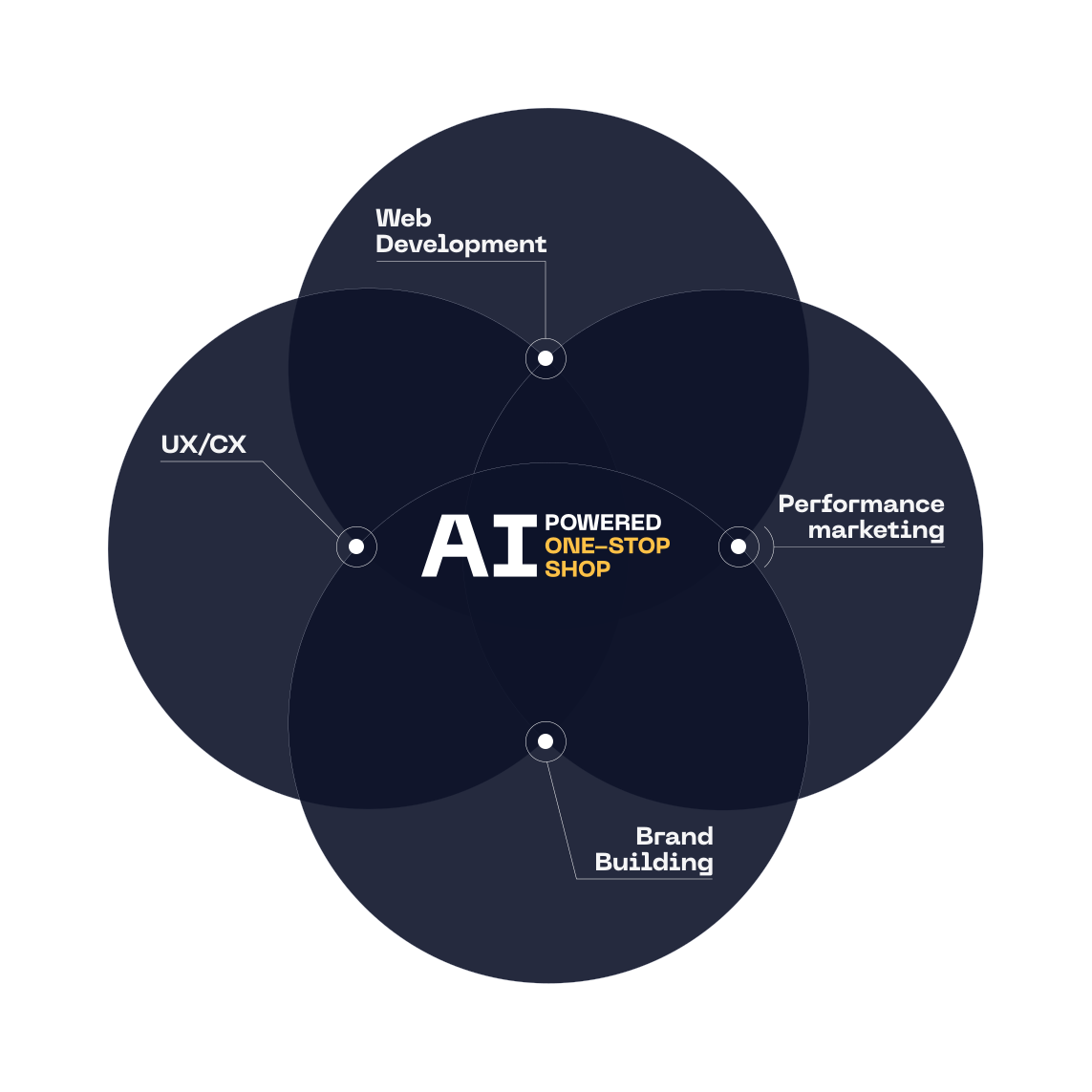
CRO in 2026 is therefore not about tricks, hacks, or darker buttons. It is about understanding people, their questions, and hesitation. About the ability to answer before the user decides to leave. At ui42, we approach this goal comprehensively. CRO is a service from our comprehensive ONE-STOP SHOP portfolio, which supports the growth of your business. We combine development, UX, and marketing into one whole, because only such an integrated approach can truly and sustainably increase the value of your business in the digital world of 2026.