Many brands feel like they are doing everything right. They have a nice website, active social media, invest in advertising, and communicate in a modern language. Despite this, they are not growing as expected. Customers do not distinguish them from the competition, campaigns are delivering increasingly weaker performance, and the question quietly begins to arise within the team: “Is the problem in marketing, or in the brand itself?”
At such a moment, a new logo or another "fresh" slogan usually doesn't help. The solution is a brand audit – a systematic diagnosis that reveals where the real problem lies. Not in assumptions, but in the reality of the brand's functioning.

Brand audit is not about the logo, but about the truth
You can imagine a brand audit as a comprehensive examination of a brand. It does not focus on one symptom, but on the entire system. It examines whether the brand works equally well internally and externally, whether people understand it, and whether customers actually experience what the brand promises them.
In practice, brand audit relies on three interconnected areas: internal branding, external branding, and customer experience. It is their harmony – or disharmony – that determines your actual brand perception.
1. It all starts with the question: Why are we doing the audit?
Start pragmatically and with an honest answer to a simple question: “What is actually bothering us?”
Sometimes it's a drop in sales, other times it's a feeling that the brand has lost a clear direction. Often the reason is the growth of the company – new products, people, markets have been added, but the brand has remained mentally stuck in the past.
Set a clear problem you are solving:
- brand perception,
- consistency of communication across channels,
- decline in performance (leads, sales, retention),
- repositioning or rebranding,
- …
Without a clear goal, a brand audit easily turns into a collection of random insights. However, when you know what you want to understand or change, the audit becomes a powerful decision-making tool.
2. Return to the brand's DNA and verify if it is still true
One of the most sensitive parts of a brand audit concerns its DNA. Many companies have beautifully formulated missions and values, but in reality, they do not live by them. Therefore, a brand audit is not about rewriting texts, but about seeking the truth.
The true identity of a brand is revealed in the decisions the company makes under pressure – when it has to say "no" to a profitable but wrong opportunity, or when dealing with a dissatisfied customer. If there is a difference between what the brand claims and how it behaves, the customer will sooner or later sense it.
3. Brand research: Why should customers choose you?
Customers do not choose brands for their features, but for the outcome they bring. This is where brand research plays an important role – interviews, data, feedback, and behavior observation.
In this step, a brand audit helps to understand why customers choose you (and why not), in what context they need you, and what their real problem is. When you understand what "job" your brand does in the customer's life, you quickly find out whether your communication talks about the essential or revolves around details that no one cares about.
4. Confront the brand promise with reality
Every brand promises something. Speed, simplicity, certainty, premium service. Brand audit, however, verifies whether this promise survives contact with reality.
If a customer expects a personal approach but experiences an anonymous process, a problem arises. And it is precisely these small inconsistencies that have the greatest impact on brand perception – often much more than the advertisement itself.
5. Internal branding: Does your team understand the brand as well as customers do?
One of the most important parts of a brand audit takes place inside the company. If employees do not understand the brand or do not believe in it, no campaign will save it. The brand is conveyed through the tone of voice, communication style, and everyday decisions.
At this point, a brand audit examines whether people have a shared understanding of what the brand means, how it should sound, and how it should behave. A brand that the team does not "live" will fall apart at the first contact with the customer.
6. External branding: visuals and communication must be one family
External branding is what the customer sees first. Website, social media, campaigns, visual identity, tone of communication. In brand audit, it is therefore examined whether the brand appears consistent and trustworthy across all channels.
Consistency is not about boredom, but about memorability. If the brand sounds different every time, the customer simply will not categorize it. Good external branding creates a feeling that everything belongs together.
Here, audit everything that is visible: logo, colors, typography, design system, website, social media, newsletters, campaigns, PR, and tone of voice (how the brand sounds when it speaks).
7. User experience: Look at the digital experience through the eyes of the customer
Today, the website and digital channels are often the first contact with the brand. Therefore, in a brand audit, it is not enough to evaluate the design – it is important how a person feels on the website, whether they quickly orient themselves, and whether they understand what to do next.
Technical problems, slow loading, or unclear structure can devalue even a very strong positioning. UX and Digital Experience is not just a technical detail – it is a full-fledged part of the brand and has a direct impact on whether people will trust it.
That is why in this step, CRO (Conversion Rate Optimization) also plays an important role. CRO helps to uncover specific pain points that customers encounter on the website, identify unnecessary steps in the process, and understand where and why people hesitate or leave without converting. In the context of a brand audit, it is not just about increasing numbers, but about aligning the brand promise with the actual behavior of users.
8. Competition: Who are you really competing with?
Competition is not just companies that look similar. It is all the alternatives that solve the same customer problem – often in a completely different way.
In this step, a brand audit helps to understand where the brand truly differentiates and where it just copies the market. Without this perspective, the brand easily gets lost in the average and its communication becomes interchangeable.
9. Customer Experience: Walk the customer's journey from A to Z
A brand is not created in presentations, but in specific moments. In how the first contact, purchase, onboarding, and problem-solving take place. A customer experience audit often reveals the difference between what the brand communicates and what the customer actually experiences.
This is where trust is most often broken – or, conversely, strengthened. Mapping the entire customer journey and "mystery shopping" of one's own brand is often one of the most powerful moments of a brand audit.
10. Action plan: less analysis, more decisions
The purpose of a brand audit is not a long document, but clear decisions. When all findings are combined, it becomes clear where the brand loses consistency, where it fails in reality, and where it has the greatest potential for change.
The best brand audits do not end with analysis, but with a concrete plan. Choose a few of the most critical problems, set priorities, responsibilities, and measurable goals. Only then does the audit turn into a real shift.
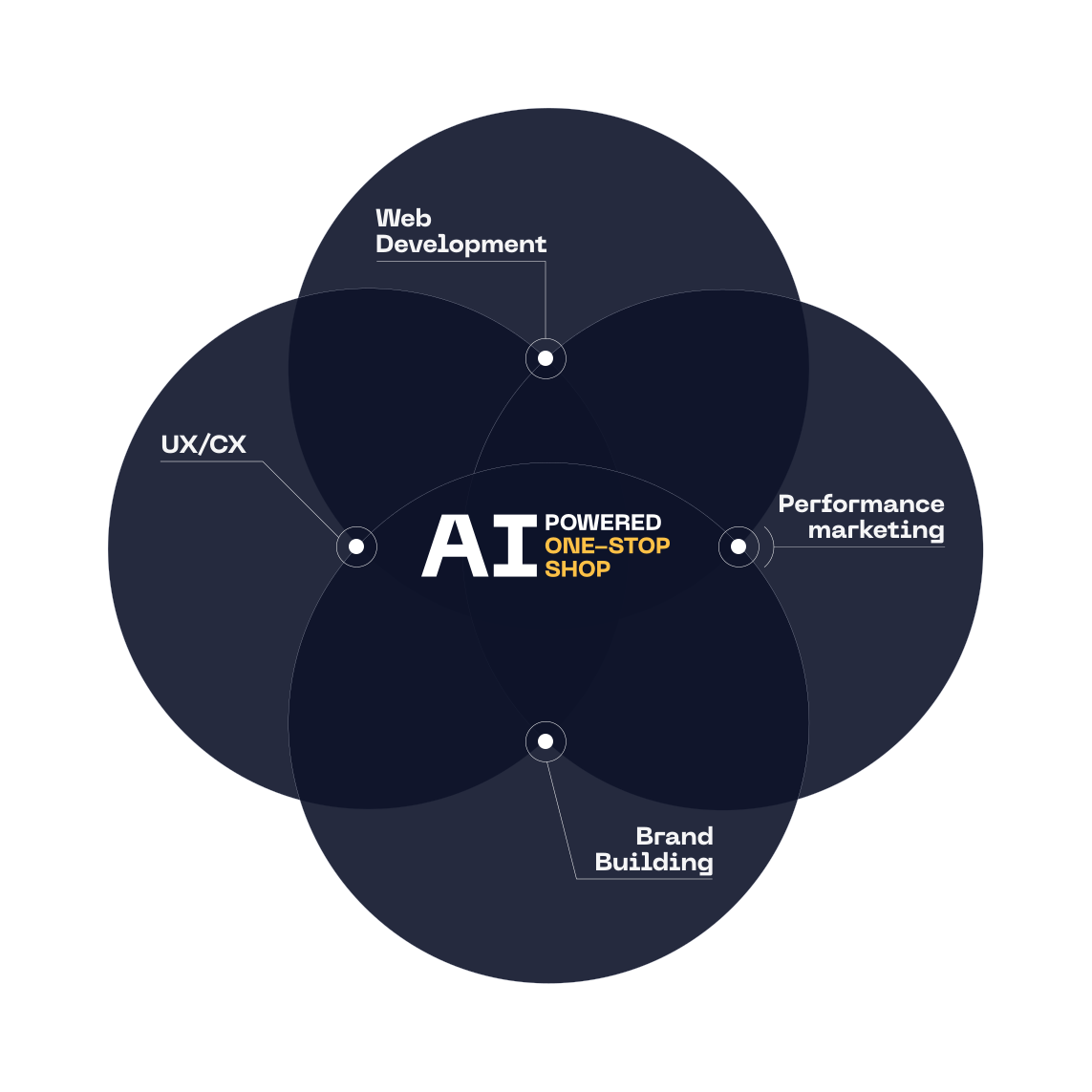
If you want to be clear about why your brand is not working as it should and what exactly needs to be fixed – from internal branding through external communication to customer experience – contact us. Brand marketing and brand audits are just one part of our comprehensive ONE-STOP SHOP solutions portfolio, which supports the growth of your business. At ui42, we connect modern web and e-shop development, UX and CX design, CRO, marketing and custom AI solutions into one functional whole, because only such an integrated approach can sustainably increase the value of your business in the digital world of 2026.