What is CLV (Customer Lifetime Value)?
What does it mean
CLV (Customer Lifetime Value), or the lifetime value of a customer, expresses the total value a customer brings to a company during the entire relationship with the brand.
Simply put: CLV shows how much a customer spends on average before they stop purchasing.
In e-commerce and digital marketing, it is one of the most important metrics because it helps understand how much it is worth investing in acquisition, retention, and loyalty building.
More info
What does the abbreviation CLV mean and why measure it?
The abbreviation CLV (Customer Lifetime Value) refers to the long-term value of a customer for a company.
It's not just about one order, but the entire relationship with the customer:
- how many times they purchase,
- how often they return,
- what their average spend is,
- how long they remain active.
That's why CLV customer lifetime value is a key metric when deciding on company growth.
If you know CLV, you can:
- set marketing budgets more effectively,
- evaluate campaign profitability,
- identify more valuable customers,
- optimize retention and loyalty.
Companies that only track acquisition costs or ROAS often don't see the true long-term value of a customer.
How to calculate customer lifetime value?
There are several ways to calculate CLV - from simple to advanced models.
A basic calculation looks like this:
CLV = average order value × purchase frequency × average relationship length
Example:
- average order: 50 €
- customer buys 4× a year
- remains active for an average of 3 years
CLV = 600 €
In practice, however, it often also involves:
- margin,
- probability of repeat purchase,
- customer segmentation,
- predictive models.
The more advanced an e-commerce or CRM system a company has, the more accurately it can calculate customer lifetime value.
The relationship between CLV and Customer Acquisition Cost (CAC)
CLV makes sense to track always together with the metric CAC (Customer Acquisition Cost), which is the cost of acquiring a customer.
The key question is:
How much can we afford to invest in acquisition to keep the customer profitable?
If:
- CAC = 20 €
- CLV = 600 €
→ acquisition makes economic sense.
However, if the acquisition cost is higher than the long-term value of the customer, the company grows inefficiently – even if campaigns seem to work at first glance.
The relationship between CLV and CAC is among the most important indicators of healthy e-commerce growth.
Tips on how to increase CLV in an e-shop long-term
Increasing CLV is not about a one-time sale, but about the quality of the relationship with the customer.
The most common effective methods are:
- offer personalization,
- email marketing and retention,
- loyalty programs,
- cross-sell and upsell,
- quality customer service,
- brand building and trust.
In practice, increasing CLV is often more effective and cheaper than constantly acquiring new customers.
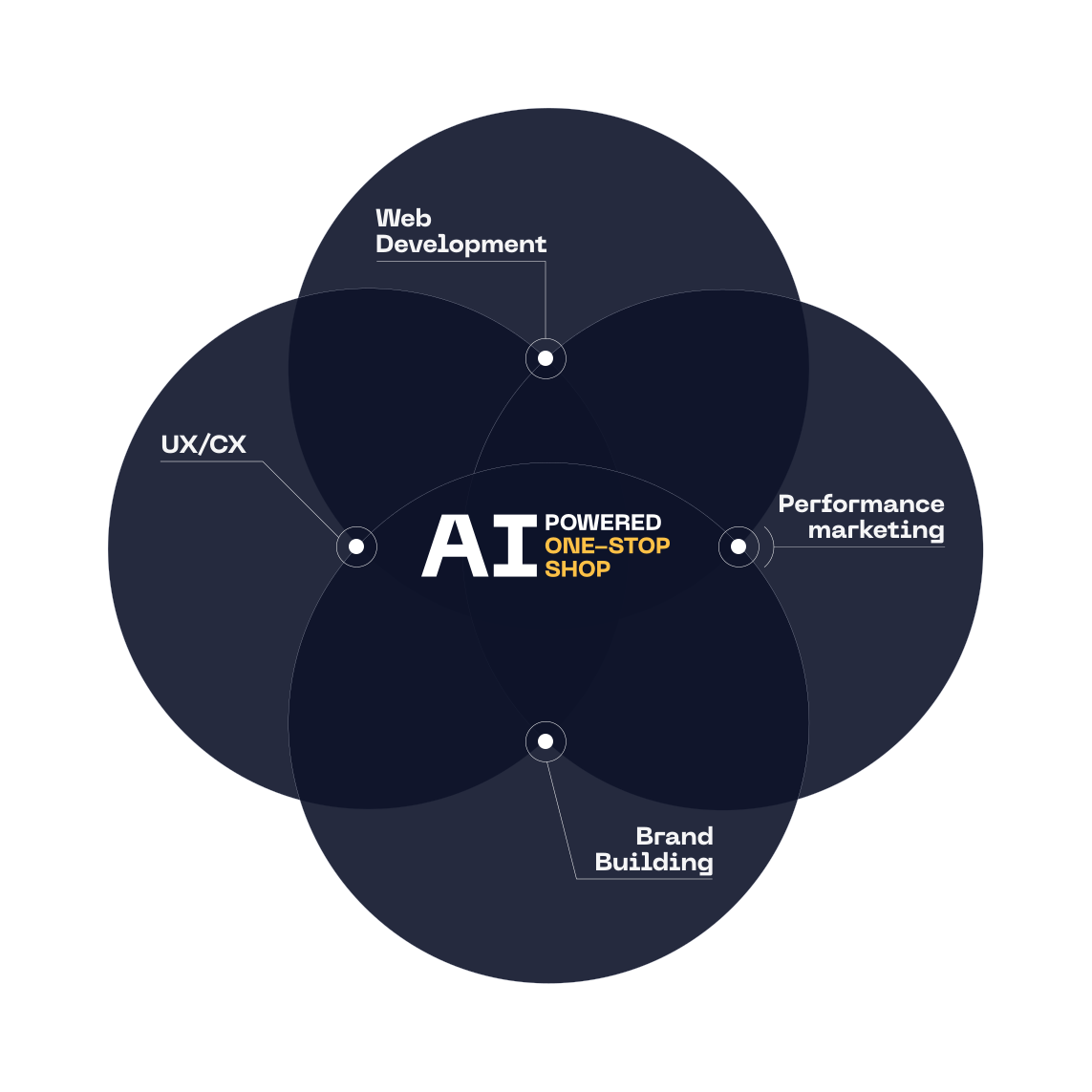
We are a ONE-STOP SHOP for your business growth. We connect web and e-shop development, UX and CX design, brand building, marketing and AI solutions into one functional whole. Because only then can digital consistently deliver performance and growth.
Latest news

Imunoklub Case Study: Unification of Two E-shops and More Value from Each Visit


ChatGPT Ads are here, are you ready?


Who is a design engineer and what do they do? A discipline at the intersection of design and code


When to start preparing Christmas campaigns?


Strategic Digitization of a B2B Company 3/3: Digitization Roadmap for the CEO

Finax Case Study: Digital Transformation of an Investment Platform Built on User Research


Strategic Digitization of a B2B Company 1/3: Why AI is Not the First Step
Google Ads update August 17, 2026: why your performance may drop and how to prepare


Shopify is not the problem. The problem is the perceptions that circulate about it.

Contact us
Everything for the growth of your business in one place
At ui42, we combine strategy, creativity, technology, marketing, and AI into one entity.
We build brands and visual identities, create websites and e-shops, design UX and CRO, create creative content, and deliver measurable results through performance marketing.
Our solutions are enhanced by FLUIDUM – ui42's AI intelligence, which transforms company data into a competitive advantage.
Thanks to this, you gain a partner who can cover the entire digital ecosystem of your business – from the first contact with the brand to conversion.
Don't miss out on the latest news from the world of UX, programming, analytics, and marketing.

Thank you for subscribing!

Get a free consultation
What do you need help with?
Select all options that apply to you
The form has been sent successfully.