Six-seven
What does it mean
If you navigate TikTok, Instagram, or online discussions about relationships, business, or lifestyle, you've probably come across the term "six–seven". It is used subtly, often ironically, but carries a strong statement about today's expectations, pressure to perform, and the image of "success".
More info
What does "six–seven" mean?
Originally, it is an abbreviation for the ideal partner or lifestyle standard, most commonly in this sense:
-
six figures – six-figure annual income
-
six feet – height of at least 6 feet (approximately 183 cm)
-
six pack – defined abs
In a newer, "upgraded" version, seven figures, meaning a seven-figure income, appears. Hence the term six–seven emerged.
However, the trend quickly shifted from the dating world to a broader cultural debate about success, self-worth, and societal pressure.
Why did it become a trend?
Because it combines several phenomena of today:
-
social media as a showcase of success
-
performance and comparison culture
-
simplifying complex people into numbers
"Six–seven" is often used:
-
ironically ("Sorry, he's not six-seven"),
-
critically (pointing out unrealistic standards),
-
or as satire on the "checklist" approach to relationships and careers.
What does it say about today's society?
The trend reveals that:
-
success is often reduced to measurable parameters,
-
a person's value is judged by performance, appearance, and status,
-
authenticity gives way to the optics of algorithms.
At the same time, it provokes a counter-reaction – more and more people are openly talking about mental health, burnout, parenting, illness, or failures. This is why "six–seven" often appears in contrast with reality.
What does this mean for brands and marketing?
For marketers and brands, "six–seven" is a signal that:
-
the audience is sensitive to pretense,
-
irony and self-awareness work better than perfect facades,
-
there is a growing demand for reality, not ideals.
Brands that can read this trend correctly do not use it literally but work with perspective, humor, and context.
Six–seven is not a goal. It's a mirror.
Ultimately, it's not about numbers.
It's about the question of what we consider success today – and whether that image serves us at all.
The six–seven trend is less about who "we should be,"
and more about why we feel it's not enough if we're not perfect.
Latest news

Imunoklub Case Study: Unification of Two E-shops and More Value from Each Visit


ChatGPT Ads are here, are you ready?


Who is a design engineer and what do they do? A discipline at the intersection of design and code


When to start preparing Christmas campaigns?


Strategic Digitization of a B2B Company 3/3: Digitization Roadmap for the CEO

Finax Case Study: Digital Transformation of an Investment Platform Built on User Research


Strategic Digitization of a B2B Company 1/3: Why AI is Not the First Step
Google Ads update August 17, 2026: why your performance may drop and how to prepare


Shopify is not the problem. The problem is the perceptions that circulate about it.

Contact us
Everything for the growth of your business in one place
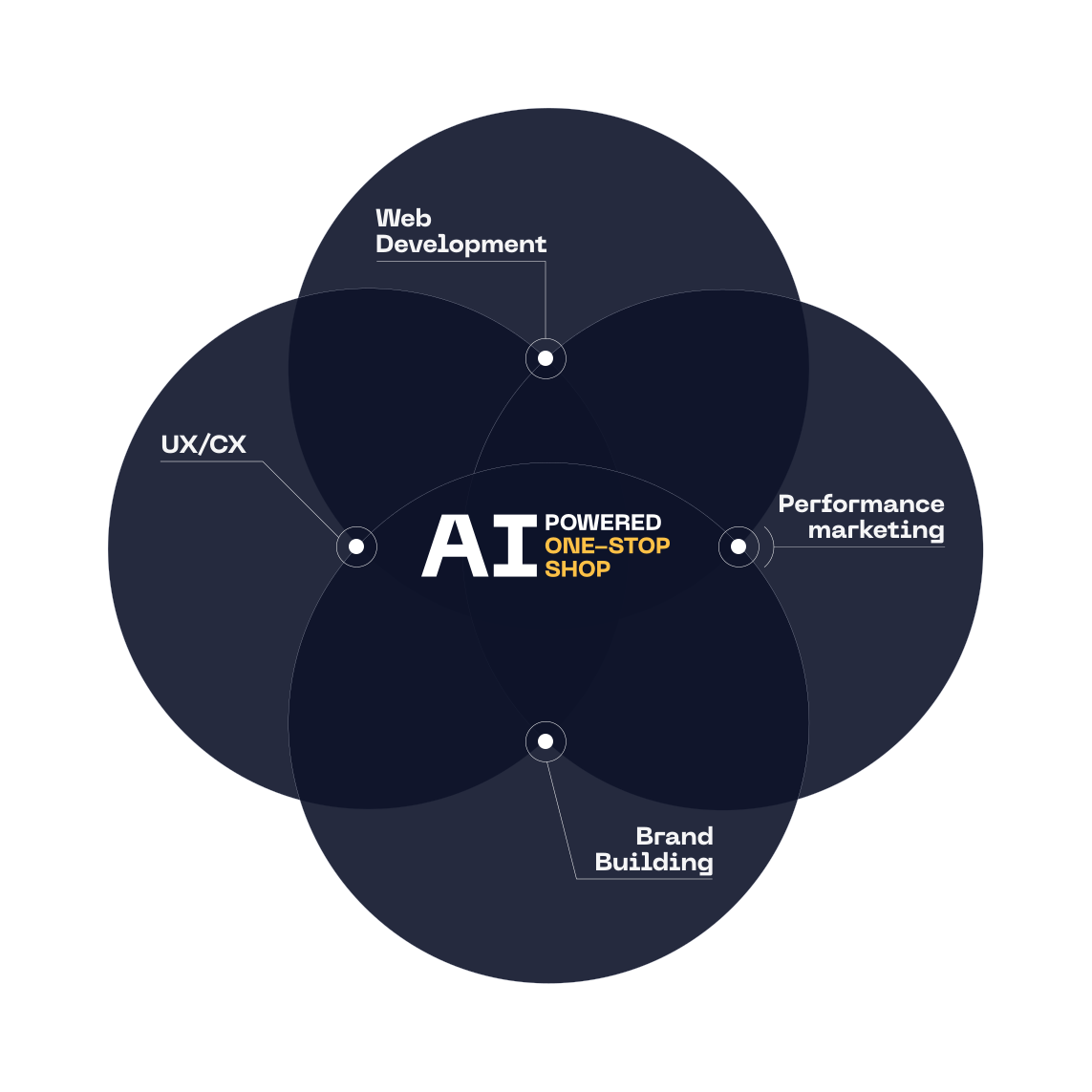
At ui42, we combine strategy, creativity, technology, marketing, and AI into one entity.
We build brands and visual identities, create websites and e-shops, design UX and CRO, create creative content, and deliver measurable results through performance marketing.
Our solutions are enhanced by FLUIDUM – ui42's AI intelligence, which transforms company data into a competitive advantage.
Thanks to this, you gain a partner who can cover the entire digital ecosystem of your business – from the first contact with the brand to conversion.
Don't miss out on the latest news from the world of UX, programming, analytics, and marketing.

Thank you for subscribing!

Get a free consultation
What do you need help with?
Select all options that apply to you
The form has been sent successfully.